Higgs Series: Realizing Newtons Dream
I now want to say in a little more detail how Newton's dream was realized. Newton first articulated his dream in the 17th century, and it really got going in the 18th and 19th centuries. However, at the beginning of the 20th century, it looked like this program was bottoming out.
Science at the turn of the 20th century:
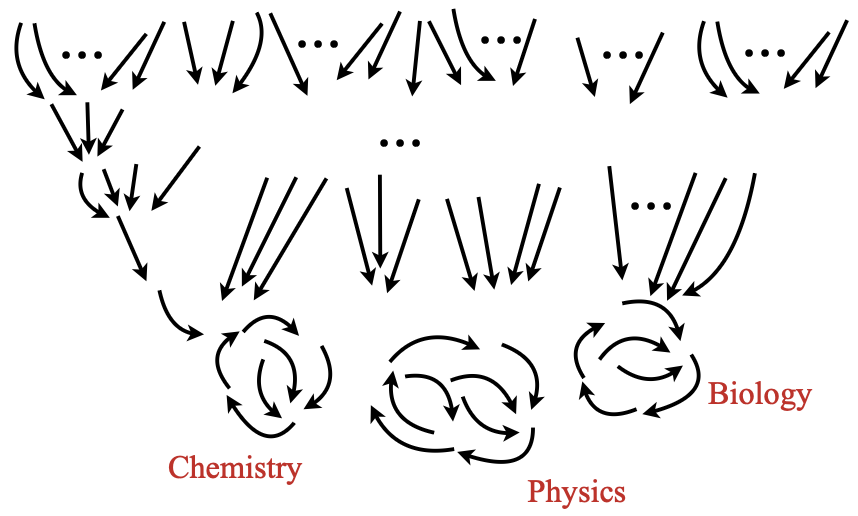
Tremendous progress had been made and we had seen some overall convergence of ideas and explanations, but it wasn't converging fully. It was hitting a wall. It was bottoming out in roughly three subgroups of ideas and explanations: Chemistry, Physics, and Biology. These ideas explained a lot above them, but were more or less self-contained independent disciplines.
Physics was able to explain a lot about the motion of bodies on Earth and in the heavens, but there were certain things it couldn't explain which were critical to Chemistry, e.g.: atomic spectra. If you look at the light coming from different chemical elements there is a characteristic pattern in the colors, a fingerprint for the element. This was incredibly useful to chemists, who were able to measure these spectra and identify which chemicals were present, in what proportion, and were even able to discover new elements in this way. So this was practically useful and was being applied in chemists' daily work, but to the physicist, it wasn't clear at all why these spectra were the way they were; there was no understanding why they should be there and, in fact, physics actually predicted that they shouldn't be there at all. It was a similar story with biology, which was largely disconnected from physics and chemistry in terms of the techniques and level of explanation used.
Another strange thing this apparent bottoming-out of Newtons dream helps explain is crazy statements from famous scientists about the fugure of physcs.
It seems probable that most of the grand underlying principles have been firmly established and that further advances are to be sought chiefly in the rigorous application of these principles to all the phenomena which come under our notice. –Albert Michelson
Michelson is basically saying there is nothing new to be discovered in physics. This quote is often trotted out now to show how naive the experts were at the time. But his quote makes perfect sense given his context [LINK]. In his mind, physics wasn't about explaining everything; it was obvious that physicists couldn't explain everything, they couldn't explain why atoms exist, let alone the strange spectra that came from them. Michelson could know this and still believe physics was more or less finished because he didn't have our modern conception of Newton's dream. What he meant by there being nothing new to be discovered in physics is that "physics" was really only the small cluster of explanations shown at the bottom of the figure. Michelson took this to be the way reality was; physics was a distinct discipline and there was no further connection to be made. Adopting this narrow view of physics, he was largely correct.
This picture, however, was radically changed by two 20th century scientific revolutions: Relativity and Quantum Mechanics. These revolutions showed us that the above partitioning was just a temporary way of organizing explanations. Once you properly include the new ideas into our scientific thinking, these subjects are seen to be not isolated; they all flow from the same deep physical principles.
Next time we will begin talking about these revolutions. We will see they were not only critical in realizing Newton's dream, but are the key players in the current drama associated with the Higgs Boson.
Floor
In the reality was explainations physics was only about the cluster of closely ideas in the figure about, not Newtons more ambitious goal of .
This will lead use to talking about revolutions in physics that happened in the 20th century.