Higgs Series: Einstein's Principle of Relativity
We saw last time that in Newton's physics we can in principle send objects as fast as we want. This means that regions that are arbitrarily far away can affect what is happening here and how. Einstein's big idea was to limit the range over which things can have an influence.
To impose this limit there are really two things that are required. The first is obvious: there needs to be a maximum speed. If the maximum speed is infinite, you can shoot a missile infinitely fast and affect what is going to happen next infinitely far away. So we need a finite upper speed limit.
The second, much less obvious, restriction is that the maximum speed must be the same regardless of how fast you are already moving. This restriction is needed to close a loophole. Last time we noted that there were two ways to get objects to arbitrarily high speeds. The first is to just make them go arbitrarily fast in a single go; our first restriction now prevents this. The second is to chain together multiple stages: rockets firing rockets. In Newton's physics, if a plane moving at the maximum speed fires a missile at the maximum speed, to an observer on the ground it looks like the missile is moving faster than the limit, twice as fast in this example. Without this second restriction we can circumvent the limit by the velocity addition rule inherent in Galileo's principle of relativity.
Einstein's radical move, and one of the things that made him a genius, was to close this loophole. He claimed that there is one maximum speed, independent of how you are already moving.
We can map these requirements to our diagrams. I'll call the maximum speed "c"; this is just a name for this constant velocity. The red line below shows an object moving at this speed. We will measure units of space and time such that the maximum speed is a 45-degree line on our figures. Our first restriction is telling us that the paths of all particles must live in the region above this line.
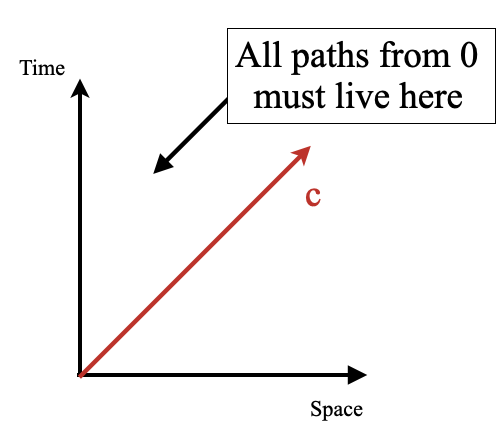
The other requirement is that if someone is moving, they still see this red line at 45-degrees as the maximum.
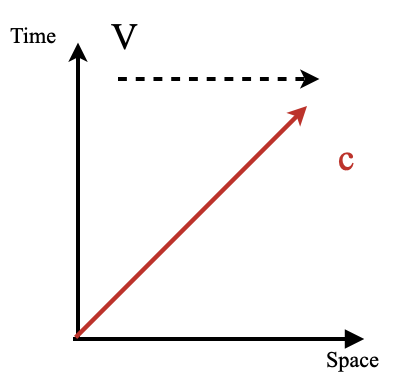
These seem like pretty simple requirements. We want to limit the range over which things can have an effect. We found we need both requirements to really make it work, but it all seems relatively straightforward. It turns out that these restrictions have profound implications on how we think of space and time and mass and energy.
We will look at some of these deep (and bizarre) implications next time.