Higgs Series: Galileo's Principle of Relativity
We are going to start talking about the first of the two revolutions that were needed to realize Newton's dream: the principle of relativity. Famously, this revolution was made by Albert Einstein. However, there is actually a notion of relativity present in Newton's laws, before Einstein came into the picture. This notion goes back to Galileo.
This is an idea that everyone is intuitively familiar with and will help us put what Einstein changed into context.
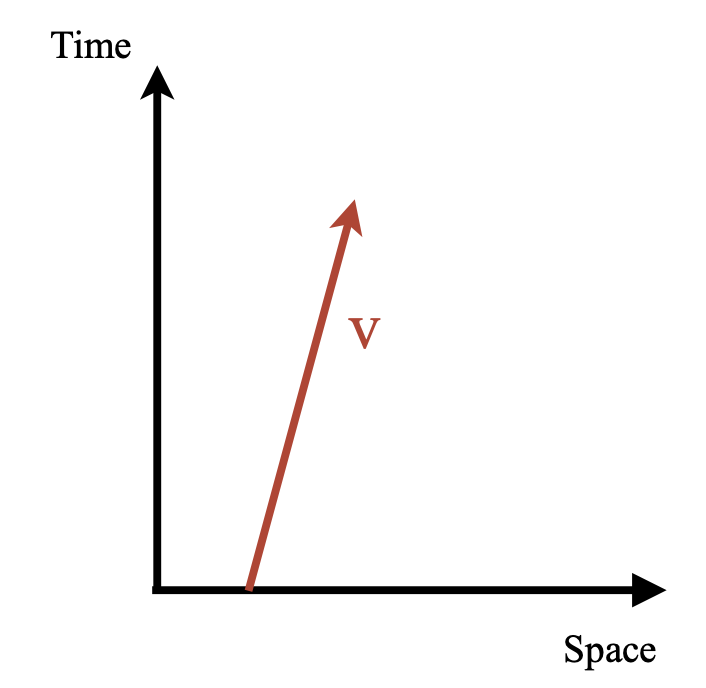
We can describe Galileo's principle of relativity in terms of our 1D figures. Let's say we have an observer at rest, someone who is standing still, who throws a ball with a constant velocity v. This is described by:
The idea of Galileo's principle of relativity is that the laws of physics look the same to this person as to someone who is moving at a constant speed with respect to them. From the point of view of someone moving at a constant velocity v (the same as the ball), the ball appears to stand still:
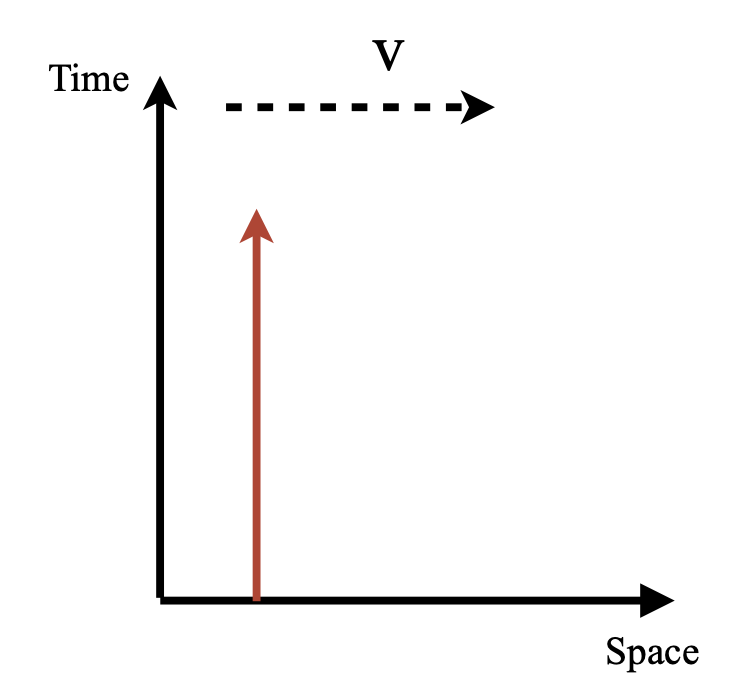
Galileo's point was that each of these ways of looking at the world is equally valid and is described by the same physical laws. This observation is a nice trick that can be used when solving problems. Often the algebra needed to describe a problem is simpler in one POV than another. Building the intuition about what is the simplest POV to take when thinking about a problem is one of the first skills that we teach physics students.
At some deep level you intuitively know this. Let's say you are traveling somewhere on an airplane. You are at cruising altitude, it's a smooth ride and the drink service is underway. You have an enormous ~500 mph constant velocity with respect to someone on the ground. However your behaviour – you pouring your $10 beverage into the plastic cup – is the same as if you were on the ground. You don't need to account for how fast you are moving. To someone on the ground, you are moving at the same high speed as your drink. From your point of view it is as if you and your overpriced beverage are at rest. This is Galileo's principle of relativity in action.
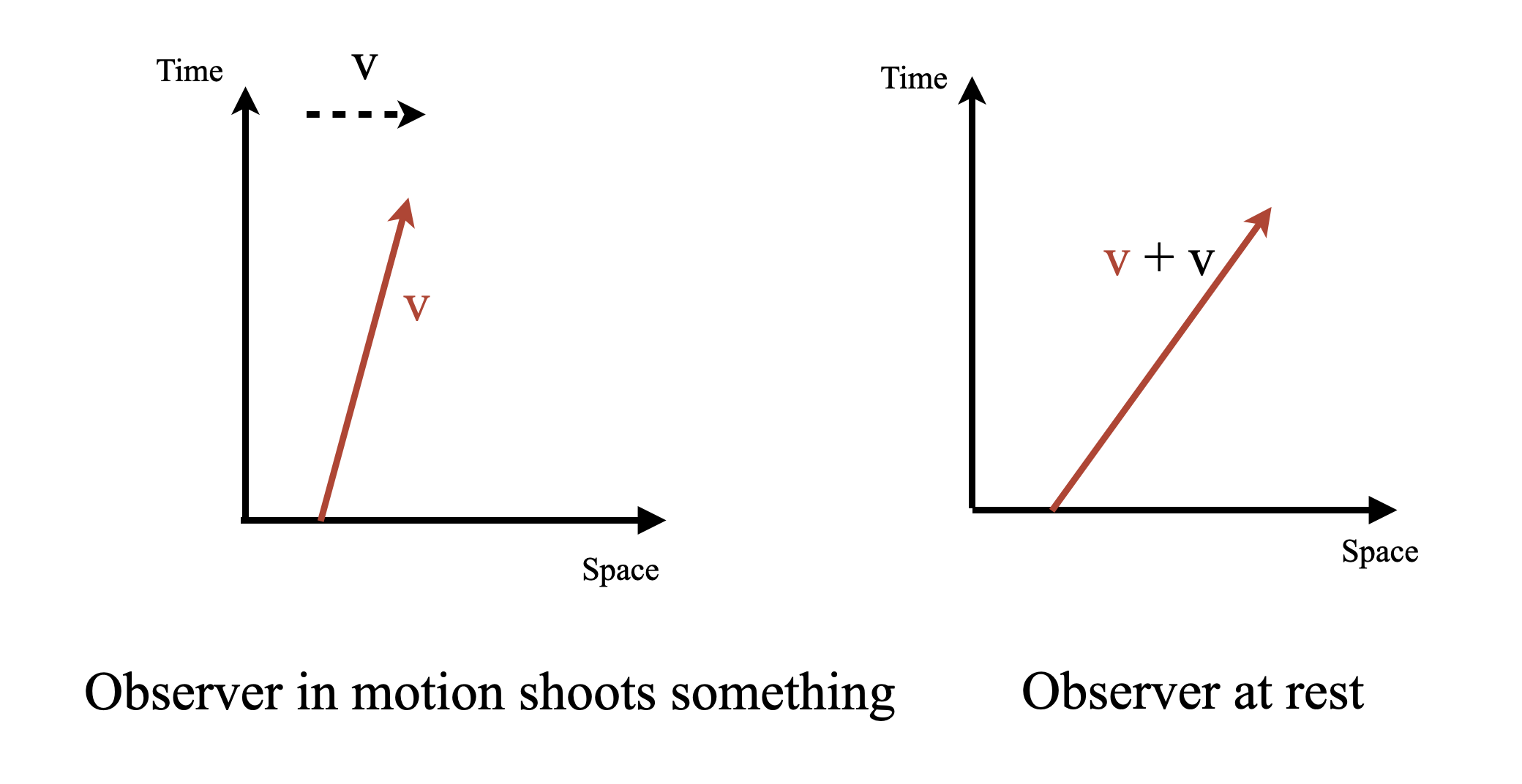
Another example. If we have an observer that is moving with velocity v, let's say in a plane, and he shoots a missile which moves away from the plane at velocity v, then an observer at rest sees the missile moving at a higher velocity, 2v. The total speed of the missile is the speed of the plane plus the speed of the missile relative to the plane. The observer at rest sees the combined speed of the object that is moving and the projectile.In pictures:
This is something you often notice in your everyday life. You are driving on the highway and are overtaking another car. You have the sense that you are slowly moving past them. It takes a while to get around them and move past them. But someone standing on the side of the road would see you both whizzing by.
Galileo's principle of relativity (which is contained in Newton's laws) tells us how relative motions combine. To the observer on the ground, the velocities simply add. An obvious consequence is that if the plane is moving faster, the final velocity of the missile is even faster:
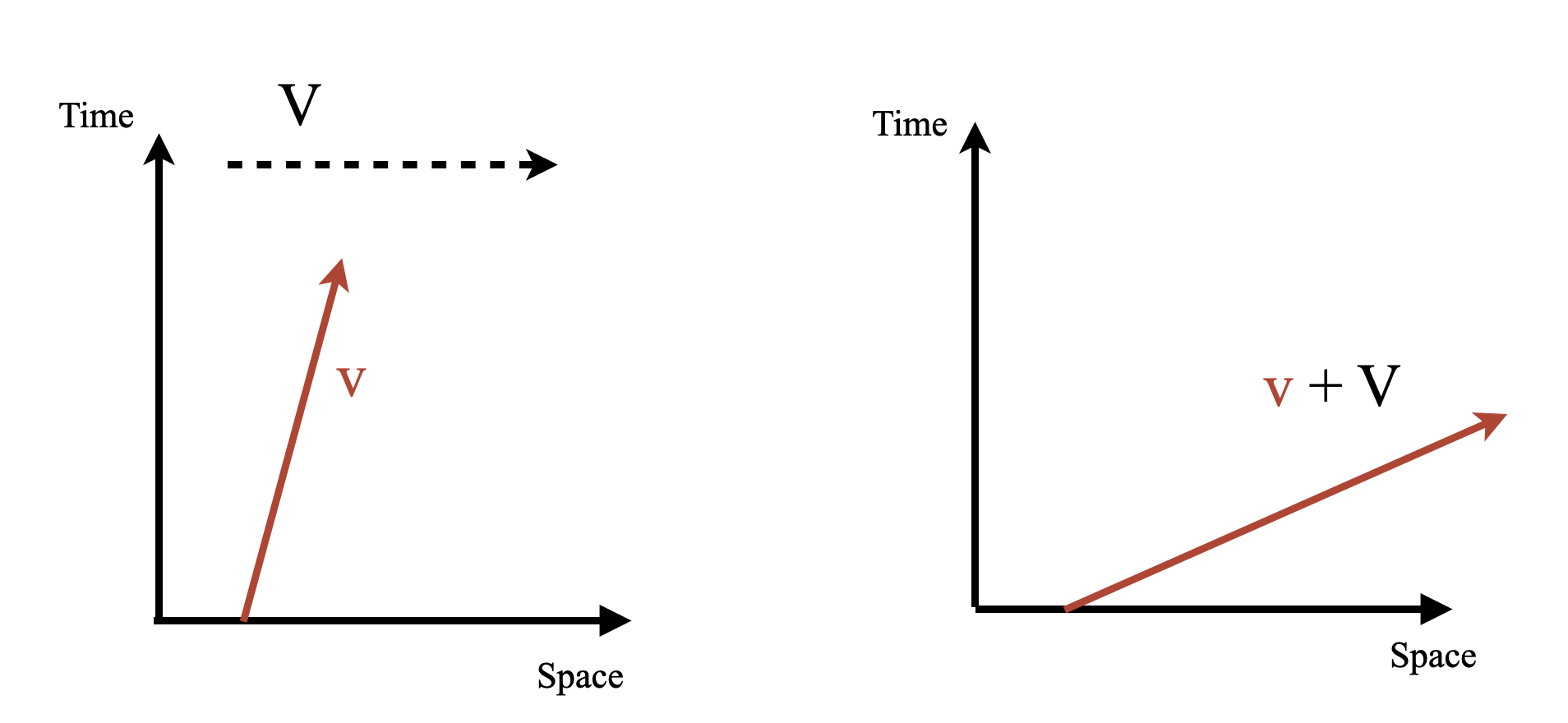
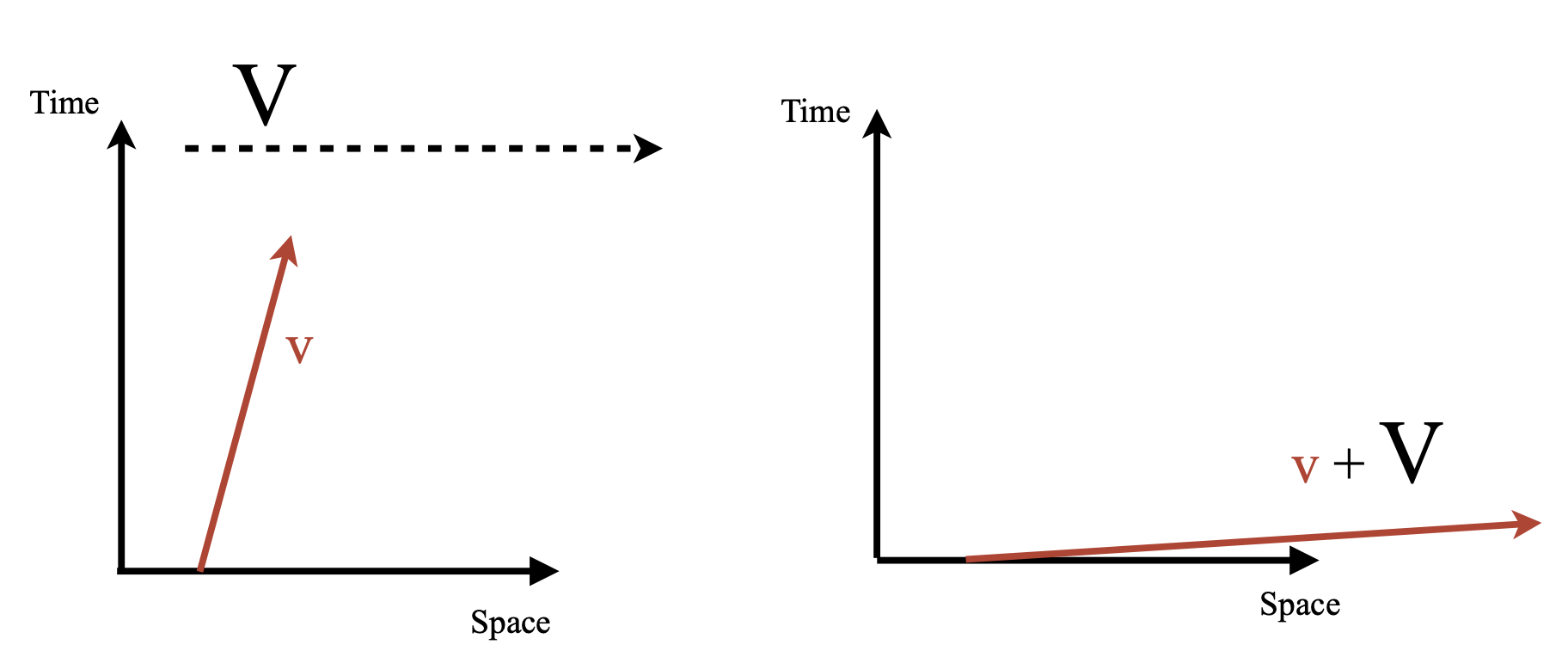
In principle, there is no limit to how fast you can make things move. Things can go arbitrarily fast as long as the initial plane (or at some point maybe we need a rocket ship) was going fast. The missile that gets shot out goes even faster.
Another way of achieving arbitrarily high speeds is by chaining many steps together. One plane, moving at speed v, shoots a missile with speed v. The missile – now moving at 2v with respect to the ground – shoots another smaller missile at speed v, which in turn shoots another…. The speed of the final missile shot from this cascade is N×v, where N is the number of steps. Again, with an arbitrarily large number of steps, you can make the final missile travel arbitrarily fast.
Arbitrarily fast things have interesting implications for physics. Regions of space arbitrarily far away can affect what is happening right here and now. In our local neighborhood, if I want to know what is going to happen in the next instant, I now have to keep track of everything happening in all of space. Regions arbitrarily far away can impact what is going to happen here if there are objects that are moving toward us arbitrarily fast.
Again, this is the situation before Einstein came around. One of the high-level ways you can think about what was revolutionary in Einstein's Principle of Relativity, is that he limited the range over which things have an effect. He removed this possibility of regions arbitrarily far away impacting what is happening locally now.
We will talk about what it takes to do this next time.