Higgs Series: Newtons Dream
We ended the first post in this series with a number of questions:
- What is the Higgs boson?
- Why was it so hard to find?
- Are we done now that we have found it ?
- Why look for it in the first place?
In today’s post we are going to begin to address: Why look for it in first place?
We will start with the basic notion of a scientific explanation: complex natural phenomena – things we observe in our everyday lives – can be explained by simpler underlying concepts. The Greeks had naive versions of this (e.g.: that everything is made of earth, wind, fire, and water, or Platonic solids). We now know that these ideas were deeply flawed, but nevertheless they had this core notion of an explanation, reducing complex things to simpler concepts. However, the notion of scientific explanation really came to life with Newton.
In his amazing work, the Principia, Newton developed modern science. This work had several major breakthroughs: He showed us that mathematics is the language scientific explanations should be written in, he invented a new branch of mathematics to do it, and he spelled out – for the first time – physical laws in this language: the laws of motion and of gravity. This is what Newton's famous work is remembered for. However, something that is often overlooked – and I think was his biggest advance of all – is what I refer to as "Newton's Dream".
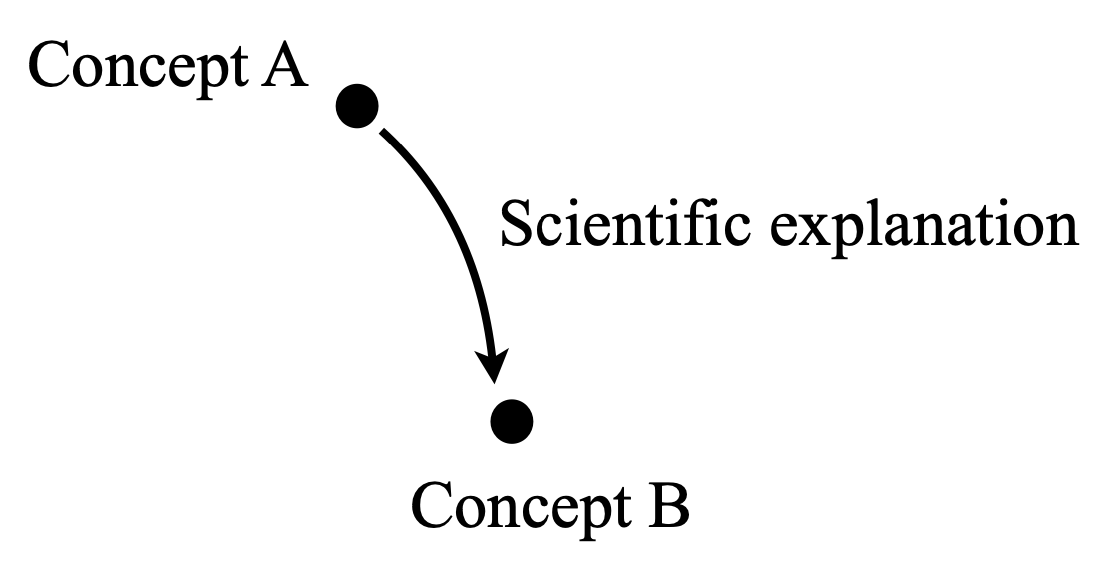
I will use cartoons to convey what I mean by Newton's dream. If there is some higher-level concept (A) that has a scientific explanation according to a law or a simpler idea (B), I'll indicate the relationship with an arrow; the arrow denotes scientific explanation.
What Newton gave us in the Principia is sketched below. He showed how planetary motion could be described by his laws, he explained how projectiles move on Earth, and described the nature and behavior of tides.
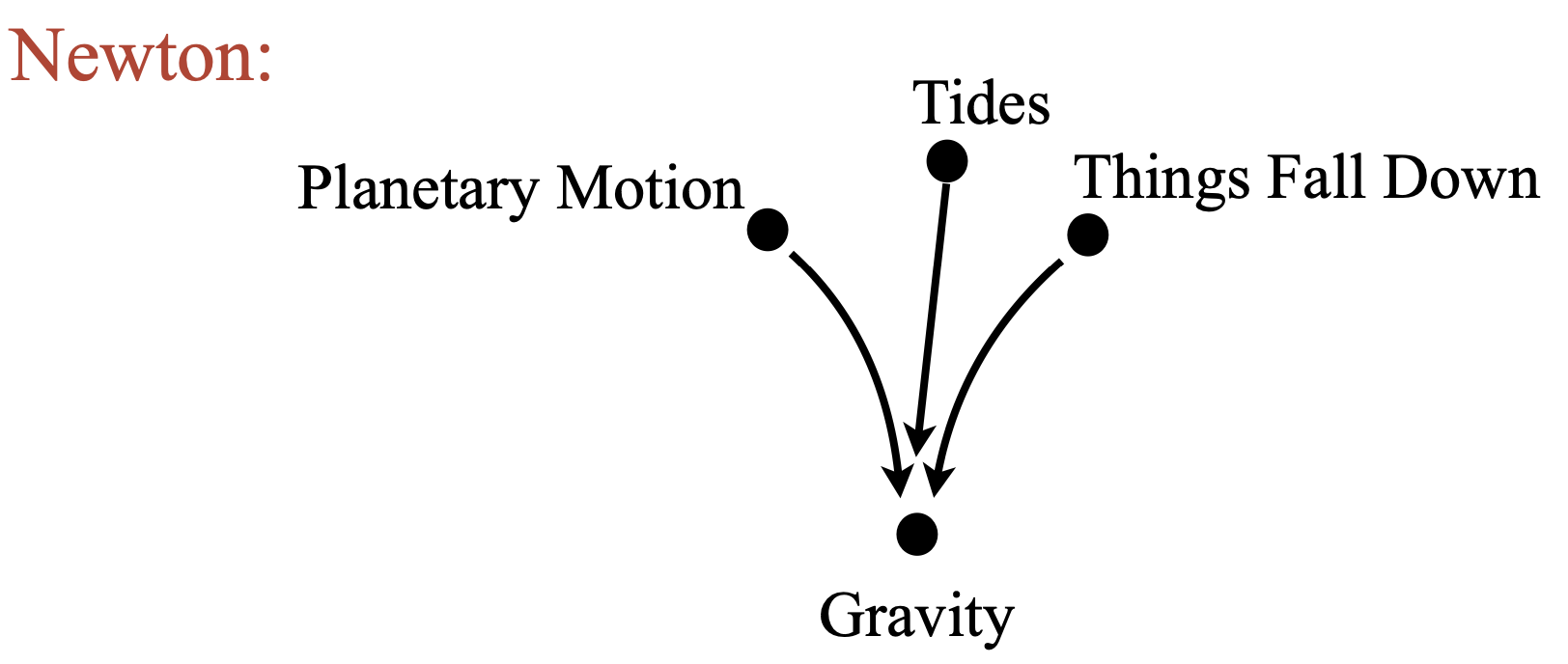
What is striking is that these three phenomena, which look very different from one another, are explained by the same underlying concept or idea. Motion of points of light in the heavens, how high the water is, and how apples fall from trees, all look totally different from one another. Newton showed that the underlying scientific explanation for all three was the same. He goes on to speculate that this can be extended to the rest of what we see in the world.
"I wish we could derive the rest of the phænomena of nature by the same kind of reasoning from mechanical principles; for I am induced by many reasons to suspect that they may all depend upon certain forces …" Preface to the Principia
This is what I refer to as Newton's Dream: to understand all of nature in terms of simple (mathematical) principles. Of course, Newton was very far from achieving it, but this is the first time you clearly see this aspiration expressed in science.
We will pick up here next time with the realization of Newton's dream and with what I think has been our greatest scientific discovery of all.