Higgs Series: Other Implications of QM: Waves vs Particles
In this post we will wrap up our discussion of QM with a few more implications that we will need later in our story.
Quantum mechanics says we can talk about particles moving in space and time but they must respect the uncertainty principle. Particles have well-defined values of various properties: mass, charge, and spin, etc. Mass and charge are more-or-less familiar; spin is an intrinsic angular momentum.
Particles behave as if they were spinning. \footnote{ we know they are not actually spinning, but they interact in ways to conserve angular momentum as if they were.} Classically, the spin of an object can be any real number you want. In quantum mechanics the allowed magnitudes of the intrinsic spin are discrete; particles can have spin 0, 1/2h, 1h, 3/2h … In general they can have spin n/2 h for any integer n. This quantization of spin is one of the things that gave quantum mechanics its name.
Another important change with quantum mechanics is how we think about identical particles. Classically, we can have two of the same type of particles, electrons say, interact. A space-time diagram of their interaction is below.
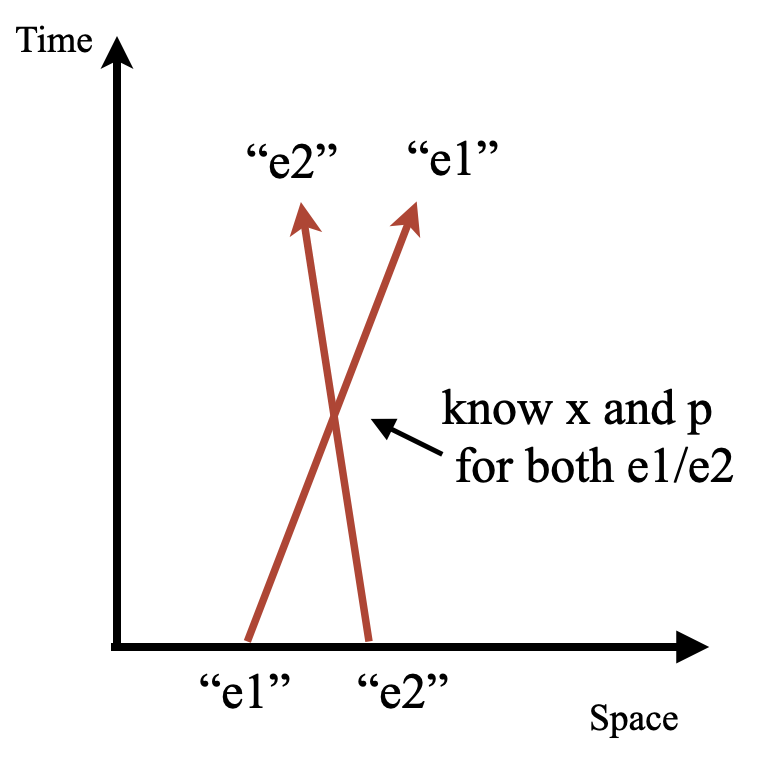
At every point in time we know each of the particles' position AND their momentum. So at any point along the diagram we know which particle is which; which is electron one and which is electron two. The infinitely thin lines of classical physics allow us to uniquely label, or distinguish, particles that are otherwise identical.
In the quantum world, the infinitely thin lines are not allowed. If we know the positions well at t=0, the interaction between identical electrons is described by the following space-time diagram.
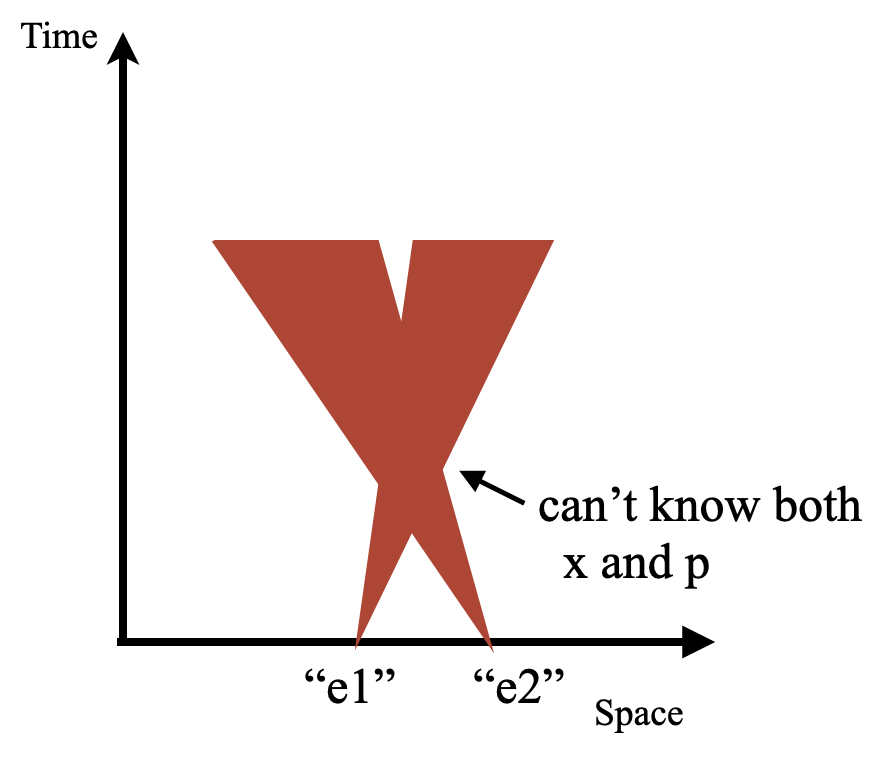
We can't know both the position and momentum of either particle at any given time. So after the trajectories have begun to overlap, we can't tell which particle is which. Maybe electron one ended up on the right after the interaction, but maybe it came in and was bent to the left and electron two went to the right. At some later time, after the interaction has occurred, we cannot as a matter of principle tell which electron is which.
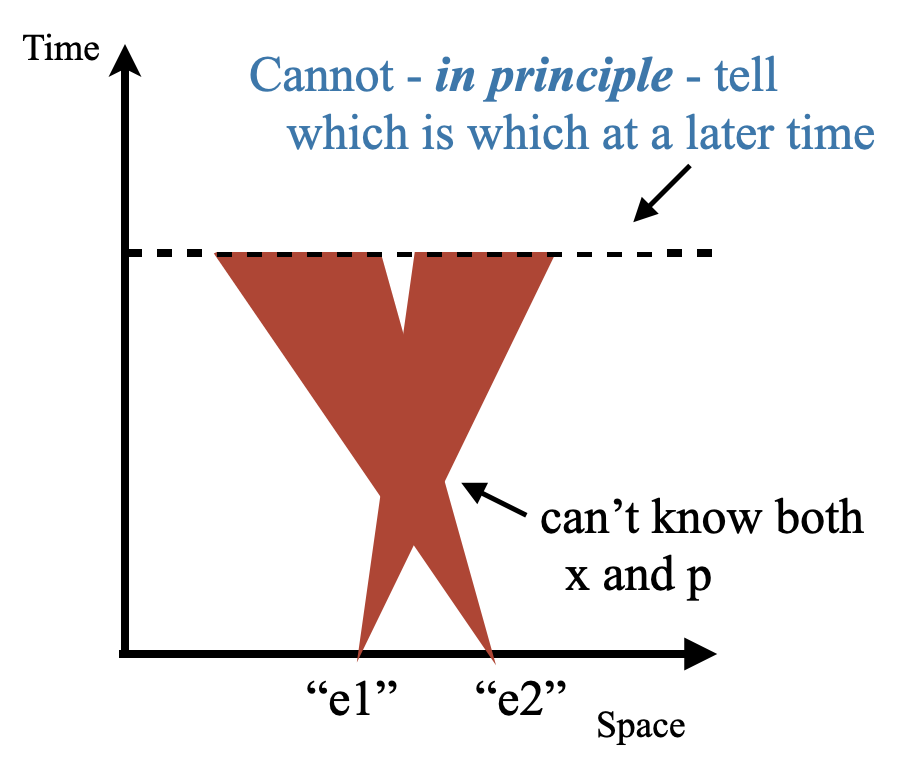
In quantum mechanics we cannot follow the trajectories of the individual particles precisely; all we have is the red blobs. This means that when the blobs overlap we cannot assign unique labels to identical particles. The theory must treat identical particles as indistinguishable. This is all a direct result of the uncertainty principle.
This has a big consequence. Identical particles cannot be uniquely labeled, so the physics cannot depend on our labelling. QM encodes the physics in terms of probabilities for events to happen and we saw that the probabilities are given by the square of the amplitude:ψ². The fact that the physics must be independent of our labelling means that the probabilities, the squared amplitudes, for our interaction must be the same if we switch labels. In equations,
ψ(e1,e2)² = ψ(e2,e1)²
The constraint is on the square of the amplitude, this means we have two options for how the amplitude itself behaves when we switch label:
ψ(e1, e2) = ± ψ(e2, e1)
When we switch the order we can either get a plus sign, we get the same amplitude back, or we get a minus sign, which will cancel when we square it. So Quantum Mechanics tells us that there are fundamentally two different types of particles: the negative-sign particles – which we call Fermions – and the plus-sign particles – which we call Bosons. We will see later that the Higgs particle must be a plus-sign particle, which is why we call it the Higgs Boson. Again this all comes back to the fact that with QM you can't trace the individual particle trajectories because of the uncertainty principle.
These two fundamental types of particles explain the confusion of the wave-vs-particle duality. Before QM there seemed to be two different forms of existence: waves (eg: light) and particles (eg: atoms). QM tells us there are only particles, but they are quantum particles that come in two types. It turns out that big collections of Fermions behave like classical particles, whereas big collections of Bosons behave like classical waves. The classical wave-particle distinction is an emergent phenomenon; it's a reflection of these two fundamental types of quantum particles.