Higgs Series: Position and Momentum in the Amplitude
In this post we will gain some insight on where the uncertainty principle comes from by looking at how position and momentum are encoded in the QM amplitude.
The uncertainty principle says we can either know the position or the momentum precisely, but not both. Here is an example of an amplitude where we know the position precisely:
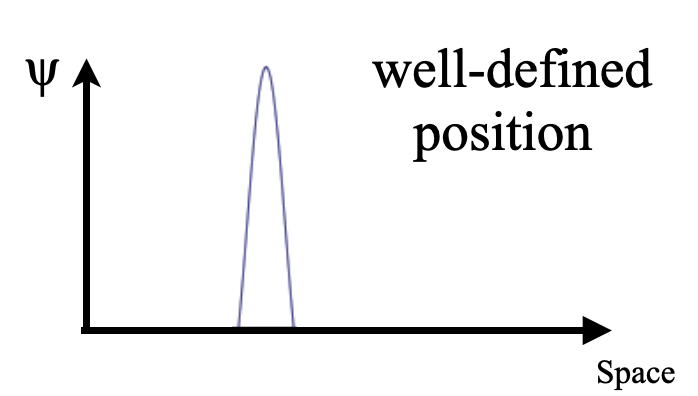
[QM is probabilistic][link] and the theory tells us the probability of finding the particle at a certain place is given by the square of the amplitude. This means that if a particle has a small uncertainty in where it will be measured, a small Δx, its amplitude will be localized in a small region of x. The position is well-defined when the amplitude, and thus the probability (ψ²), is sharply peaked in one place.
The amplitude of a particle with a well-defined momentum looks totally different:
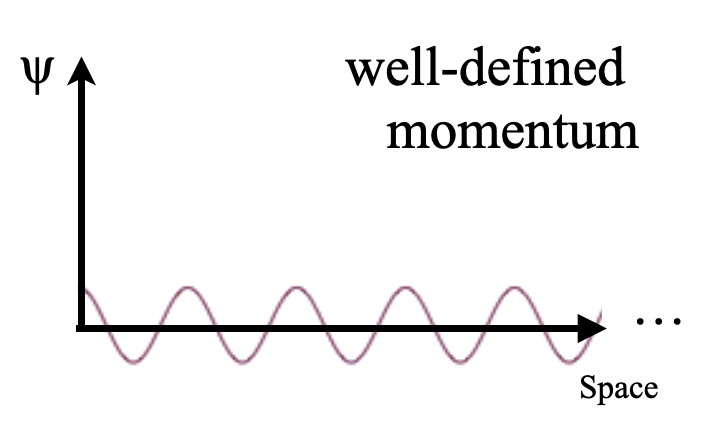
What characterizes the momentum in QM is the distance between peaks in the amplitude. An amplitude with a well-defined momentum has a constant, regular spacing between peaks.
You can immediately see that the notion of well-defined position is totally at odds with that of having a well-defined momentum. If you are well-defined in position, you only have one place where the amplitude is big, one peak; the concept of what is the difference to the next peak is meaningless. If, on the other hand, you have a constant distance to the next peak, then there are many different positions where the particle can be with large probability.
In a real sense, the amplitude of a particle with well-defined momentum is made up of different amplitudes that have different well-defined positions; it is a bunch of little peaks shifted with respect to one another. It's also true – but harder to visualize – that the amplitude of a particle with well-defined position is made up of amplitudes that have different well-defined momentum. How this works is sketched below.
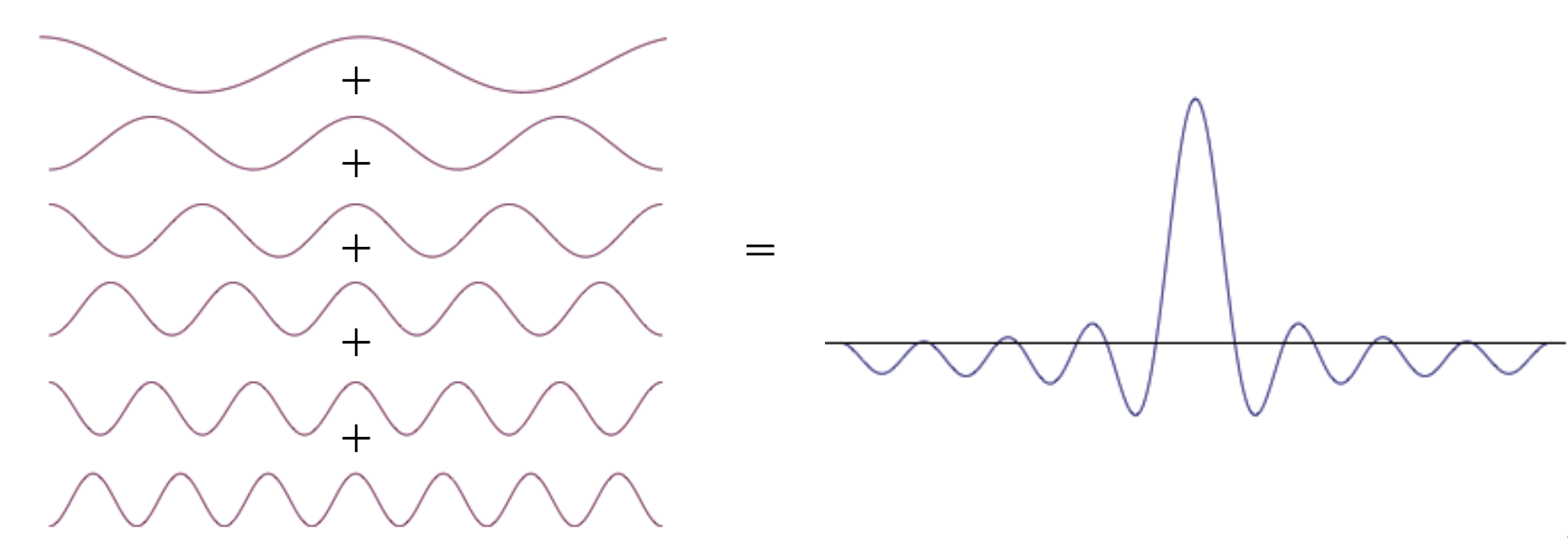
The big idea is that if you add the amplitudes of a bunch of waves that each have different wavelengths, they can give a combined wave that is peaked at one location. The above shows what happens if you add six different waves. As you add more and more waves with shorter wavelengths, the peak gets larger and sharper. So an amplitude that is localized in one position can be thought of as the sum of many amplitudes that each have different well-defined momenta.
Here we see that the uncertainty principle is not a result of our ignorance or our inability to design a careful position-and-momentum detector, it's a fundamental feature of how position and momentum are encoded in the amplitude. This in turn follows directly from the fact that according to QM the amplitudes evolve in time as waves.
The above examples are the extreme cases, where either the position or momentum is exactly defined. In practice we often deal with particles that have reasonably well-defined position and reasonably well-defined momentum. The uncertainties on both are small but non-zero, bounded by the new QM constant, h. An amplitude for this particle would look like:
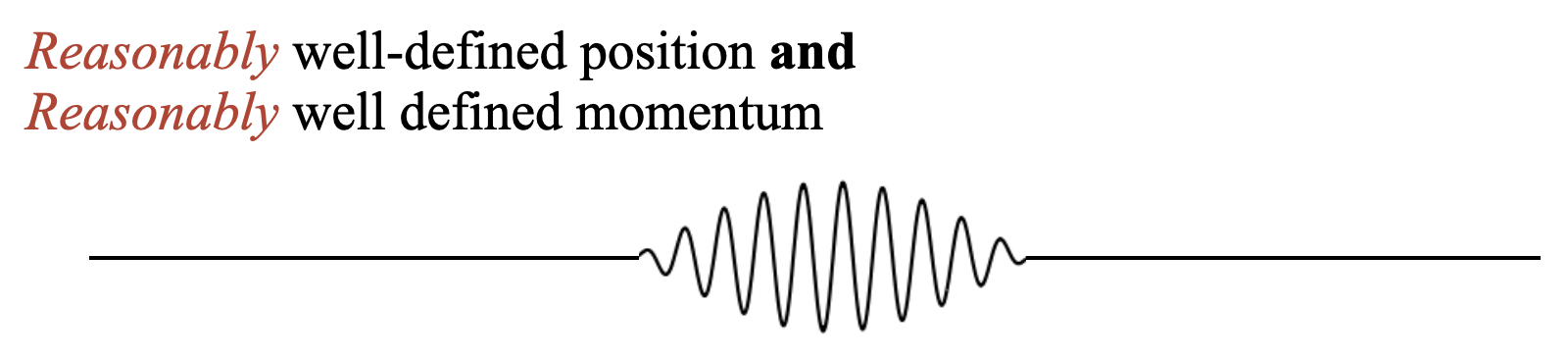
It's fairly well localized. The probability of finding the particle to the far left or far right is essentially zero; the amplitude is zero far from the center of the figure. However, within the central region there are several peaks and the distance between them is fairly constant.
The big upshot of this was discussed in the [last post][link]. If we think of quantum particles moving in space and time we cannot use infinitely thin lines. We have to use thick shapes, where the thickness is set by a new constant of nature (h) that appears in the quantum theory.
We will see next time how this solves our problem with the apparent instability of matter.