Higgs Series: Relativity's Effect on Mass
One final thing we need to understand about relativity is its effect on mass. Not only does relativity change our conception of time and space, it also changes how we fundamentally think about mass. There are many ways to see this; we will focus on one that is closely related to what we will talk about later.
The following is a cartoon of a particle accelerator – like the Large Hadron Collider – accelerating a proton. We do this by constraining the proton to move in a circle and giving it a little kick every time it goes around. Magnetic fields are used to keep the protons in a circle and electric fields are used to give the kicks. The kick or force applied to the proton leads to a small increase in the proton's momentum every cycle.
attrorg: :width 500px
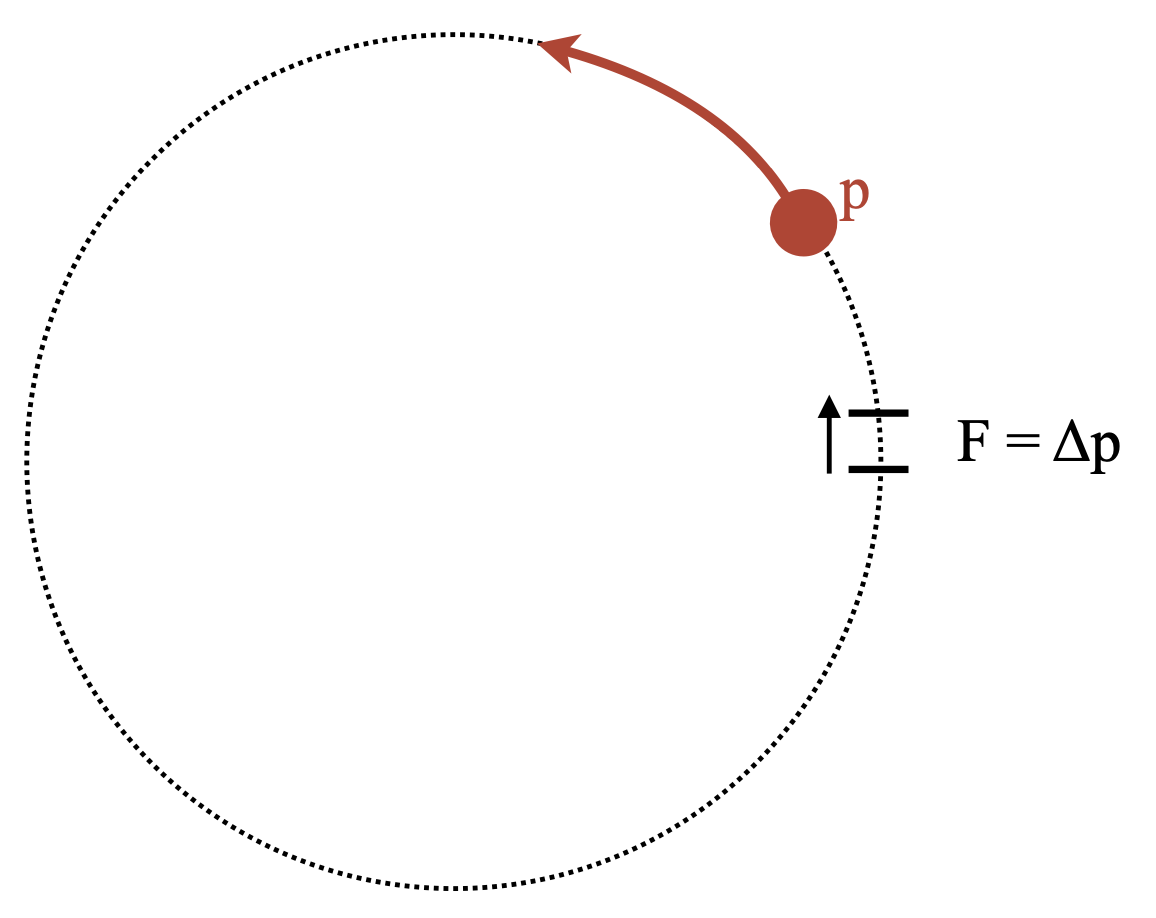
The total change in momentum after going around many times is given by the size of the kick for each cycle times the number of cycles. Remember the momentum is given by mass times velocity. So we have.
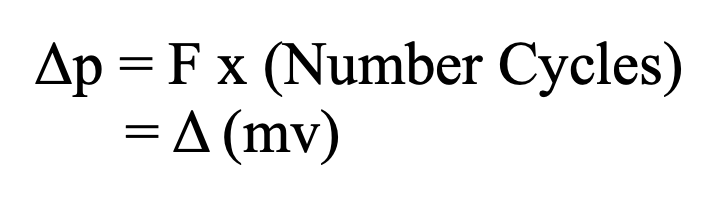
What's interesting is that the number of cycles can be arbitrarily large; the proton is stable and we are able to keep it in a circle pretty much as long as we want. The force is a fixed number we also control, the size of each kick. So this means the total change in momentum can be arbitrarily large. However, the velocity cannot be arbitrarily large; this was the whole point of Einstein's relativity. As you start increasing the proton's momentum, the kicks increase the proton's velocity v. As we keep doing this, at some point the proton bumps up against the speed limit; it's now moving nearly at the speed of light. Now we seem to have a problem: every cycle increases the proton's momentum by a fixed amount, but the proton's speed cannot increase, it can't go above the limit. Once the proton's velocity is near the maximum upper limit, the only way the proton's momentum (mv) can be increased is by increasing m. Our notion of mass must also change to accommodate an upper speed limit; mass increases with speed.\footnote{Another, ultimately less confusing, way to interpret what is going on is to redefine momentum to keep the mass independent of speed.}
Thinking more carefully about how the mass must change leads directly to the famous E=mc². Again there is a lot more that we could say about relativity and the implications of a finite upper speed limit, but we have now covered the pieces that we need for our story. Next time we will start discussing the other 20th century revolution in physics: Quantum Mechanics.