Higgs Series: Space-time
We saw last time that time is not absolute. Different observers viewing the same events see them happening at different times, and even in different sequences, the order depending on the direction in which you are moving.
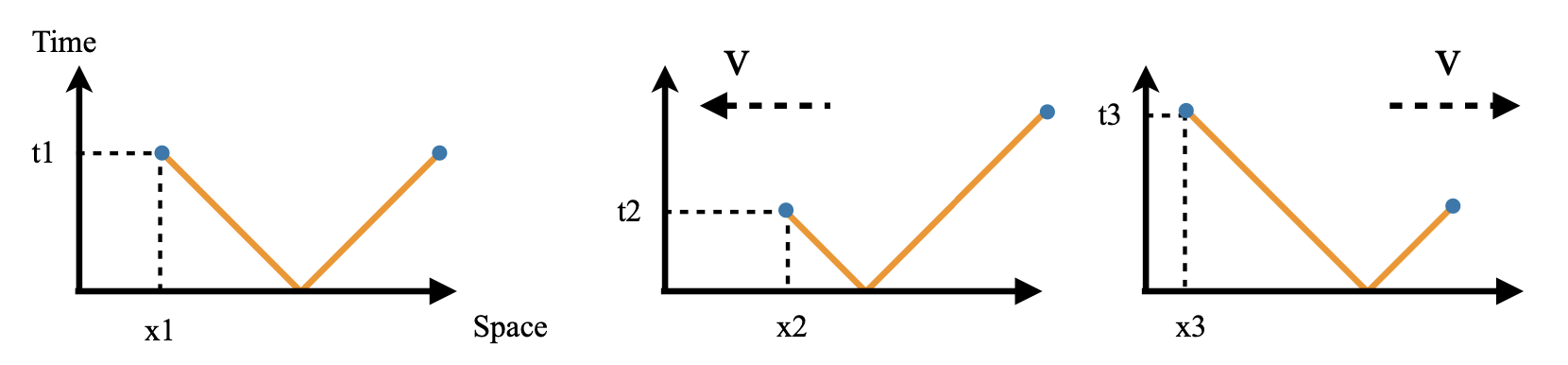
There is, however, one thing that all the observers do agree on: the maximum speed. This was one of Einstein's assumptions, to avoid the rockets firing rockets loophole. So while the times (and locations) at which the observers see the light hit the walls are different, they are related. Let's focus on left-going light. The observers all measure different positions and times for when it reaches the wall: (x1,t1), (x2,t2), (x3,t3). However, they all agree that this light was moving at c.

Physicists like to rewrite this by squaring both sides and subtracting:\footnote{In our case it's not obvious that this is the right thing to do. But with a slightly more complicated example, it's easy to see why you want to square both sides, instead of some other power... happy to go through this if there is interest.}

We refer to this combination of x and t as "the interval". So while the different observers disagree on the actual times and distances measured, they agree on the value of the interval: x² - (ct)². Unlike the time or place between two events, the interval has a unique value, independent of the observer's point of view. We say the interval is invariant to how you are moving, or invariant to your point of view.
This talk of invariants may seem abstract. However, you are already familiar with a direct analog: the length of an object. An object's length is independent of the angle at which you look at it; it is invariant to your perspective. Imagine you want to measure something, e.g., the length of the quad at Carnegie Mellon. To one observer – looking along a particular direction – it may look like this:
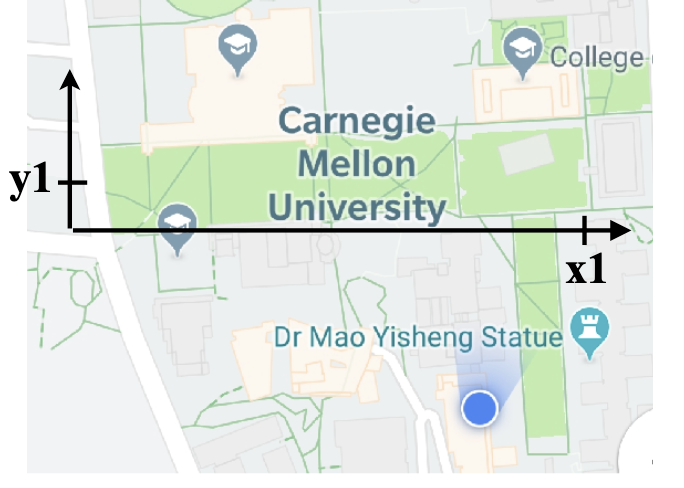
In this coordinate frame the quad has a large distance along the x direction, but a small distance along y. However, another observer looking at the quad from a different angle might see:
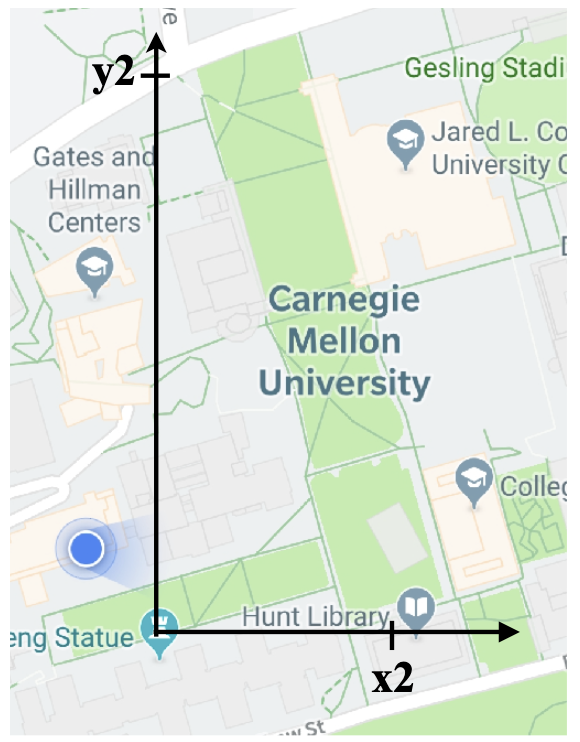
Observer 2 measures the quad with a relatively large value of y, and a relatively small value along x. These observers are looking at the same thing. They disagree on the extent of the quad in the x-direction and the extent in the y-direction, but agree on the length (L): x² + y². The coordinates (x, y) change from perspective to perspective, but the length L, the combination x² + y², is invariant.
This analogy can be nicely summarized geometrically. Different observers, with different perspectives, measure different values of x and y, but they all agree that the measured values lie on a circle of radius L.
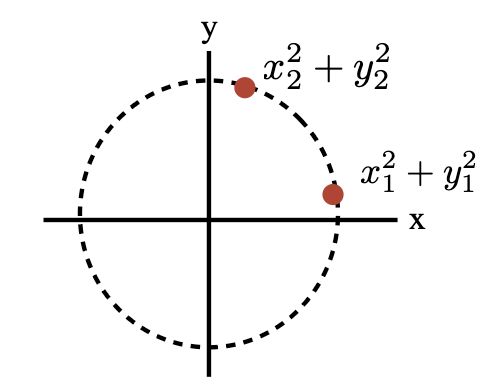
As your perspective changes, you move along the circle. So, by changing your angle, you are mixing the x- and y-extents; you are trading some length along y for length along x.
In our lightbulb example, a similar thing is happening and can also be viewed geometrically. The following shows a space-vs-time diagram centered on the light hitting the left-hand wall of the room.
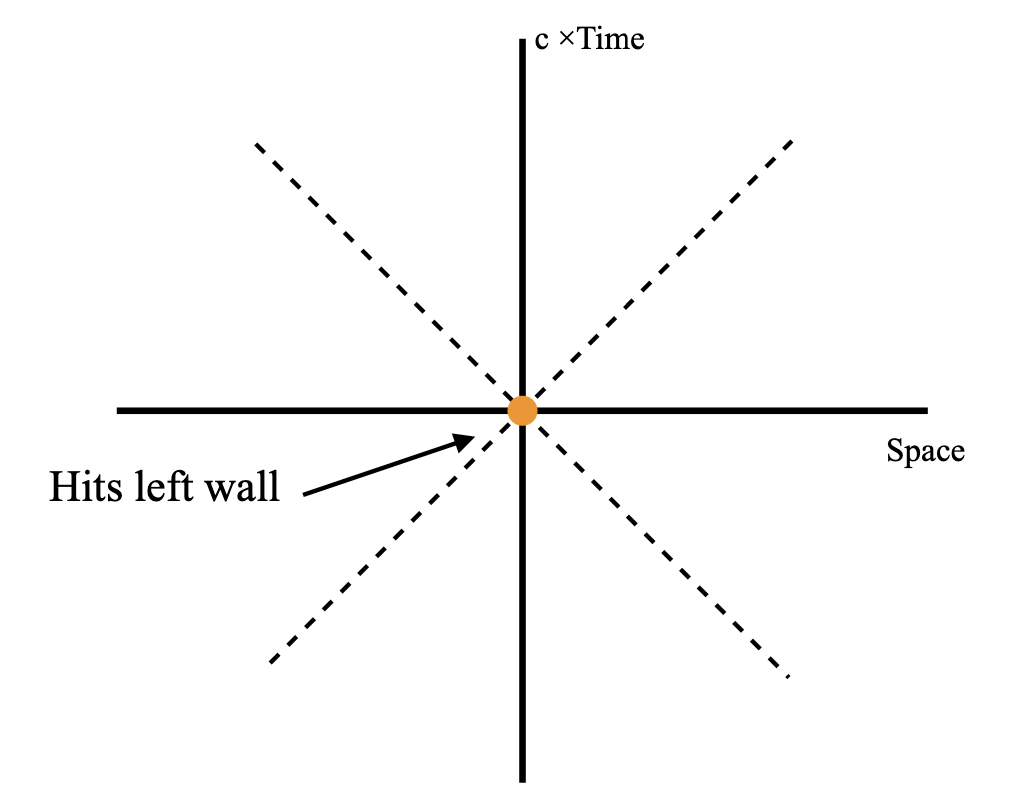
For the observer at rest in the room, the right-going light beam hits the right wall at the same time and is displaced in space by the length of the room.
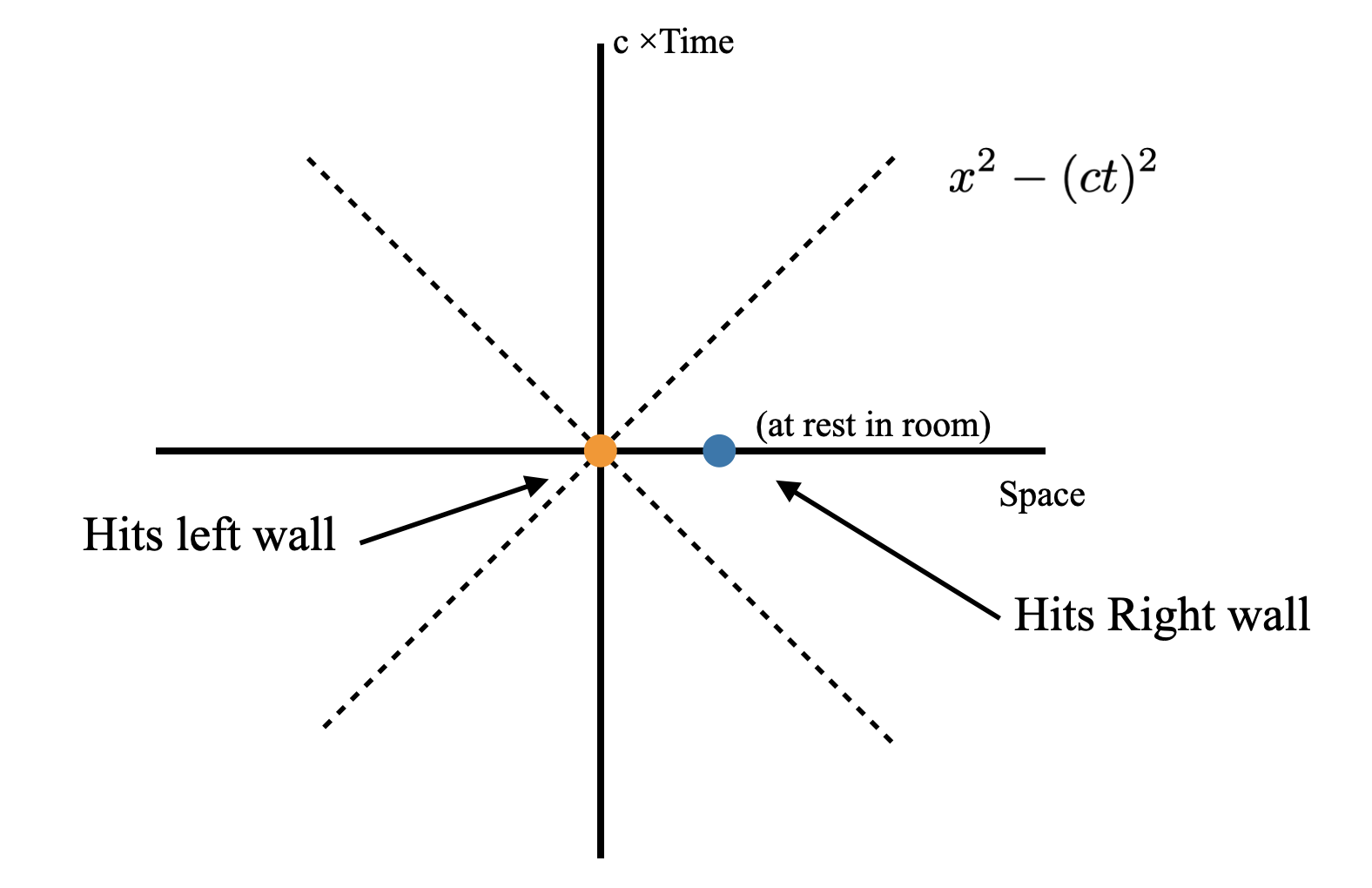
The running observers see the right-going beam hit the wall either later or earlier, depending on the direction they were moving.
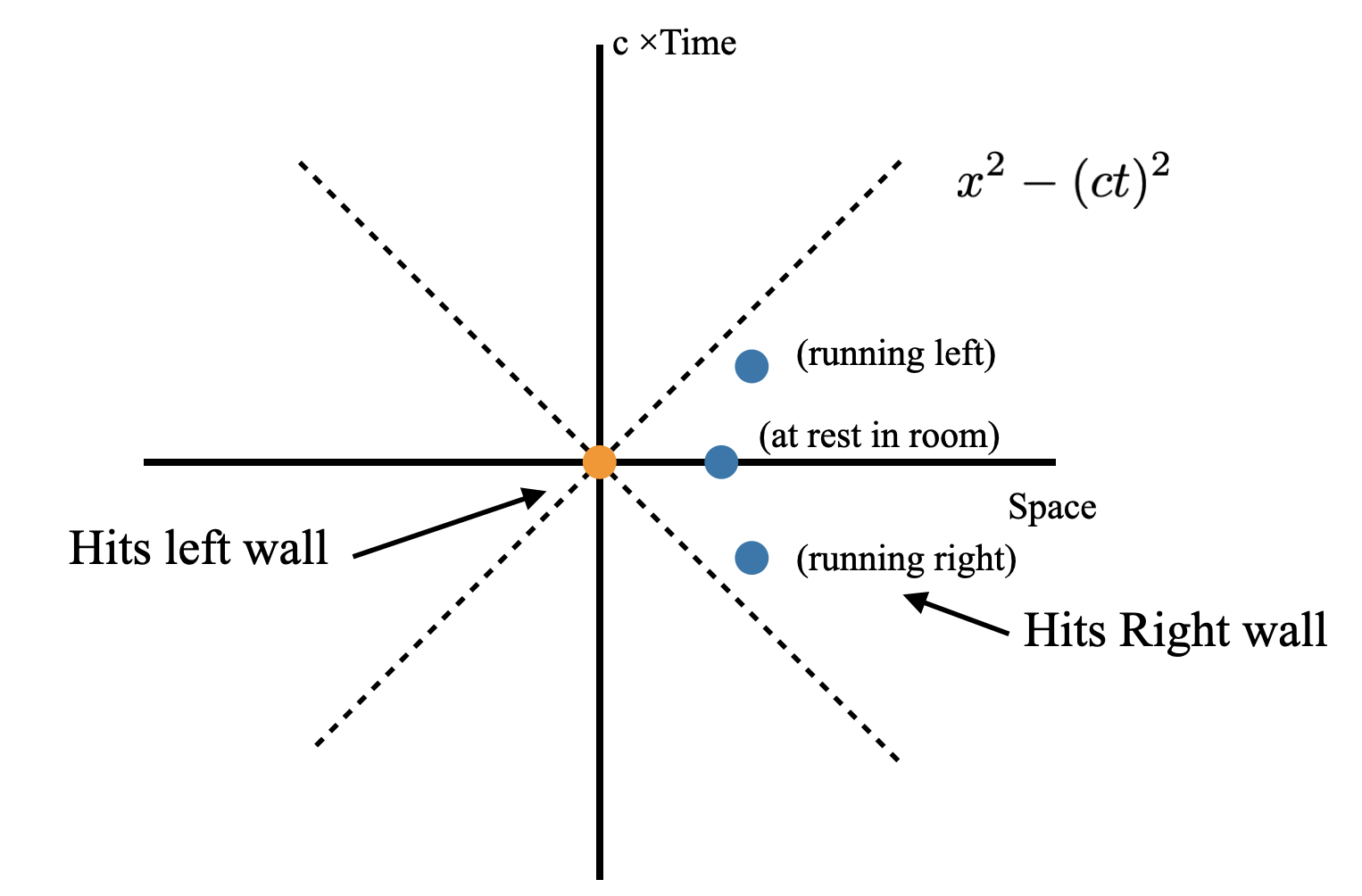
Like in the length analogy, the different observers disagree on the positions and times when the right-going beam hits the wall (relative to when the left-going beam hits). However, they all agree that it lies on the line x² - ct².
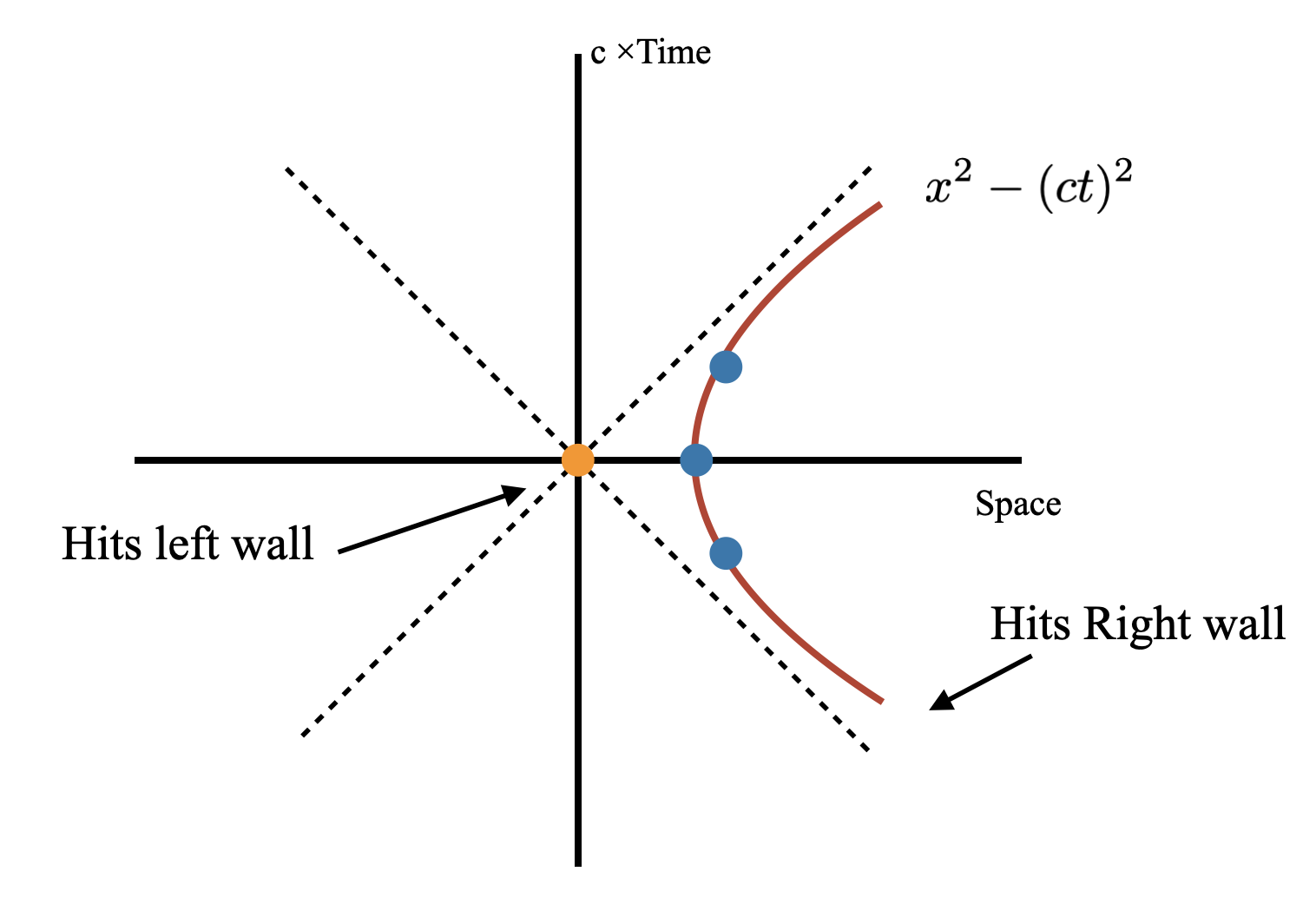
This is exactly analogous to the case of the circle when you are measuring length. There, different observers see different components of x and y, but they all lie along a circle. Here, the different observers see different values of x and t, but they all lie on the hyperbola x² - ct². By changing points of view – which now means changing your velocity with respect to the room – observers move along the hyperbola. In the length example, we were mixing space with space (x with y), here we are mixing space with time. Algebraically it is nearly identical. However, with space-time mixing there is a crucial minus sign in the invariant x² - ct², compared to the more familiar plus sign in the length x² + y² with space-space mixing.
What all this is telling us is that space and time do not exist independently on their own. They are projections of one underlying thing that is real: space-time. Our intuitive folk notion of space and our intuitive folk notion of time are different projections or views of this deeper structure. The x and y components of an object do not exist independently of the perspective of an observer; changing perspective changes the x and y. What has real independent existence is the length of the object and its relationships to other objects. It is the same for events in space-time. It is the space-time interval between events that has real independent existence.