Higgs Series: Stability of Matter
Post
We have now introduced the main upshots of Quantum Mechanics. But how does this solve our original problem of the stability of matter?
Our model of the atom – let's take Hydrogen for simplicity – was of a negatively charged electron attracted to a positively charged proton by the electromagnetic interaction. The proton's mass is about a 1000 times larger than the electron's, so to a good approximation the proton just sits still while the electron moves. The electromagnetic force in this case is an attractive inverse square law, as it is for gravity, and would thus lead to the electron orbiting the proton. The size of the atom would be set by the size of the orbit.
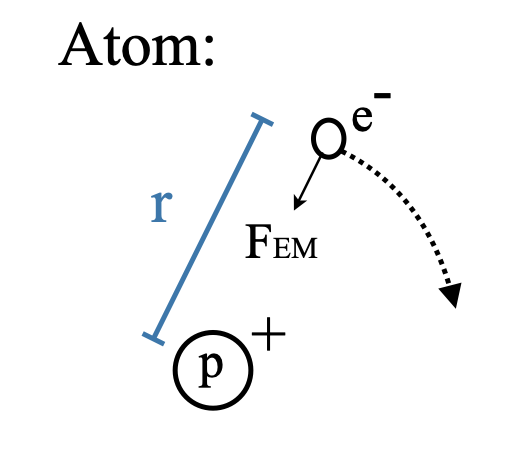
This all looks like we are in pretty good shape. However, the same EM interaction causing the electron to be attracted to the proton also causes the electron to radiate light as it orbits. The electron must constantly change the direction of its velocity to stay in a circle (or an ellipse). This changing velocity is an acceleration, and EM tells us that accelerating charges radiate light \footnote{if the frequency of the acceleration is lower, the charged particles radiate radio waves, which is how radios work}.
The radiated light will carry away some of the electron's energy. This in turn causes the electron to move closer to the proton, lowering its potential energy. But now the electron is orbiting in an even tighter circle, which means it's accelerating more than before, so it will radiate even more, which leads to yet smaller orbits, which … . This quickly leads to a runaway effect where the electron loses all its energy to radiation after less than a billionth of a second. The electron ends up not moving (no kinetic energy) and sitting directly on top of the proton (no potential energy). Here is a spacetime diagram of what happens classically as an electron falls into the proton.
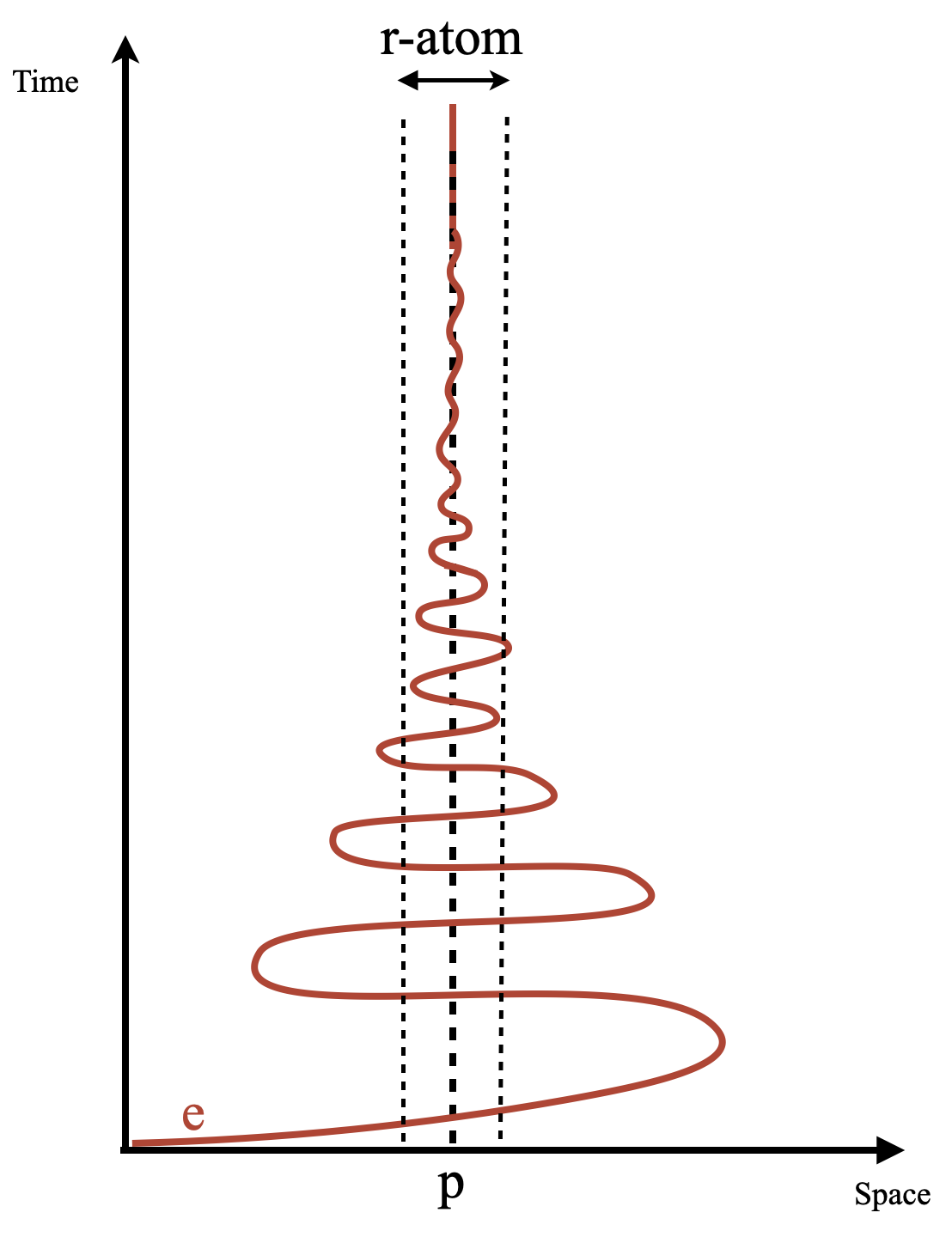
The planetary model of the atom, where the electron is attracted by the EM force, is unstable with a lifetime of about a billionth of a second. So a straightforward prediction of the classical theory is that atoms shouldn't exist.
What to do? The obvious things to try to change are either 1) the model of the atom – maybe atoms aren't light electrons orbiting heavy nuclei – or 2) the EM force holding the atom together – maybe EM is wrong in some way or maybe we need a new force for atoms? It turns out that both the model of the atom and the EM force are correct and the change needed was much more radical, a change to the way electrons are allowed to move in space.
Here is what our atom looks like with QM:
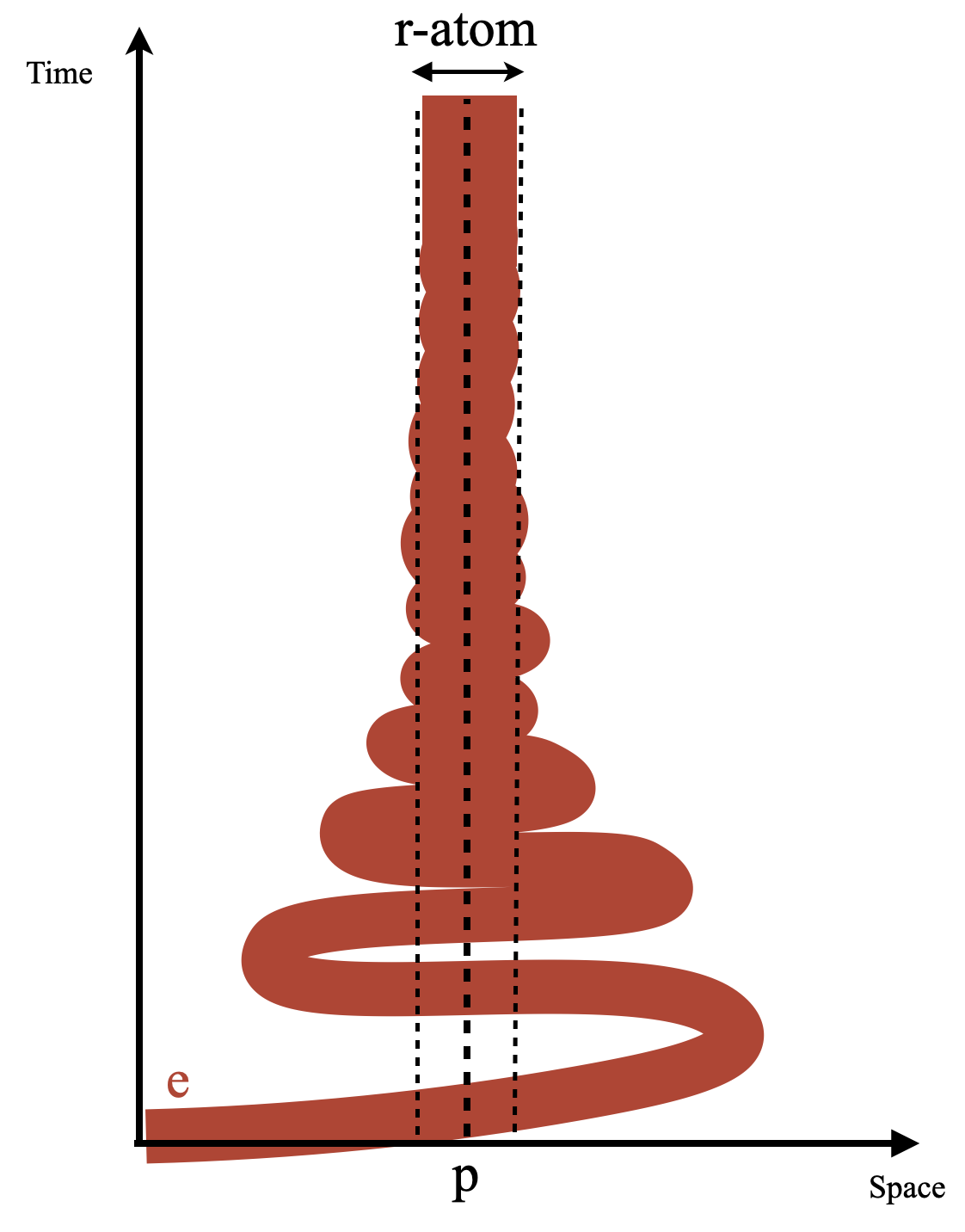
The general behaviour is similar to what is predicted classically. As the electron approaches, it begins to orbit the proton; it very quickly loses energy to radiation and orbits at smaller and smaller radii until eventually it is "sitting right on top" of the proton.
The difference is in the end state. Classically the electron is right on top of the proton (Δx = 0) AND not moving (Δp = 0). This infinitely thin line in spacetime is outlawed by QM. The uncertainty principle says there must be a non-zero thickness to the line, and it's exactly this thickness that sets the size of the atom.