Higgs Series: The Need for Quantum Mechanics
We are now going to turn to the second of the revolutions in physics that were necessary to realize [Newton's Dream][link]. The first revolution was nearly the direct result of just one person: Albert Einstein. Einstein of course was a genius but he is still just one person and he was able to develop relativity in a year or so. The second revolution, Quantum Mechanics, was of a much more radical character. It was much harder; it took the whole field – including Einstein – a couple decades to really understand what was happening.
Why was QM so much harder than relativity? In relativity, Einstein took concepts that we were already familiar with—space, time, and energy —and taught us the proper way to think about them. Quantum Mechanics, as we will see, was a much more radical change; it threw away much of what came before and invented new, more abstract, mathematically formal concepts to replace them. QM was a much more dramatic departure from the physics that came before it. Like with relativity, an entire series of posts could be devoted to Quantum Mechanics; we will just focus on the big picture changes that were brought by this revolution and the pieces that we will need later for our story.
A good starting point for our discussion is the picture of atoms before the advent of QM. Atoms were known to consist of negatively charged electrons and a positively charged nucleus. Most of the volume of the atom is taken up by the electrons, whereas most of the mass comes from the nucleus. The electromagnetic force – which was relatively well-understood at the time – was thought to be responsible for holding atoms together. There was a solid experimental foundation for this basic picture, but there were many problems with this model.
The first problem was that the electromagnetic interaction predicted atoms would not be stable. If you happen to arrange a negatively charged electron to orbit a positively charged nucleus, it should almost immediately, after ~10⁻¹¹s, spiral in and collapse right on top of the nucleus. So it wasn't clear why matter was stable at all; how were atoms able to keep their size?
Another thing that was strange was the way that atoms interacted with light. We knew that atoms could absorb and emit light; this was predicted by the theory and observed to happen. However, the theory predicted that atoms should interact with all frequencies or colors of light, whereas it was seen that only discrete values of light interacted with atoms. Moreover, different atoms had completely different patterns of colors they interacted with. Here are some examples:
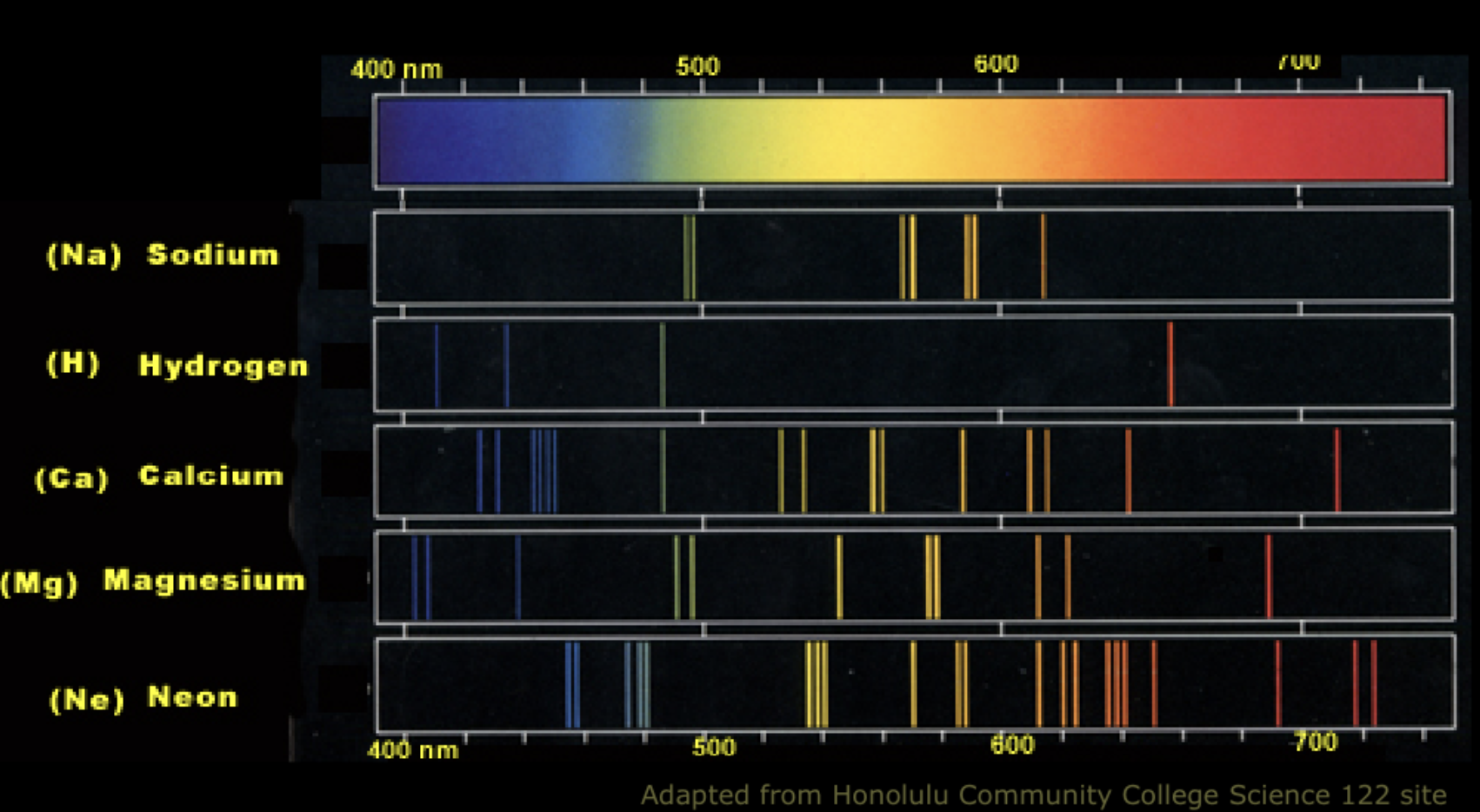
The top continuous spectrum is what you would expect the light interacting with atoms to look like given the theory. Whereas the spectra below were what was actually observed for a few different elements. These unique patterns were incredibly useful for chemists, who could use them to fingerprint elements present in a given sample, but were totally unexpected from the underlying physical model.
Another closely related worry at the time was an inherent wave-vs-particle duality of nature. There were things in physics that looked like particles, e.g. the atoms. There were other things that behaved like waves, e.g. the light that interacted with the atoms. The relationship between these wasn't clear. Were there really two different fundamental modes of existence? Or was one somehow more fundamental, more real, than the other?
Before quantum mechanics there were many problems in describing even the most basic things in our everyday lives.
There was a long period of confusion, filled with many false starts and wrong turns. There were several ad-hoc and competing ideas that were able to give partial answers which could explain some of the riddles, but not others. Eventually the ideas settled down into a unified and consistent theory, which we will start describing in the next post.
Now you might think, "OK there is a problem with our description of atoms… the solution should either be a modification of the structure of atoms, i.e.: our picture of what they are made of, or maybe the model is right but we need a modification of the electromagnetic force that holds the atoms together." These are the two obvious things you would think to change. It turns out that both the model and the electromagnetic interaction were correct. The solution was much more radical: it was to change the way the electrons were allowed to move, and it required a completely new framework for all physical processes.