Higgs Series: The Uncertainty Principle
This post discusses another major outcome of quantum mechanics: the uncertainty principle.
Before QM we could describe our world in terms of space-time diagrams. For example, the following shows a particle moving at constant velocity:
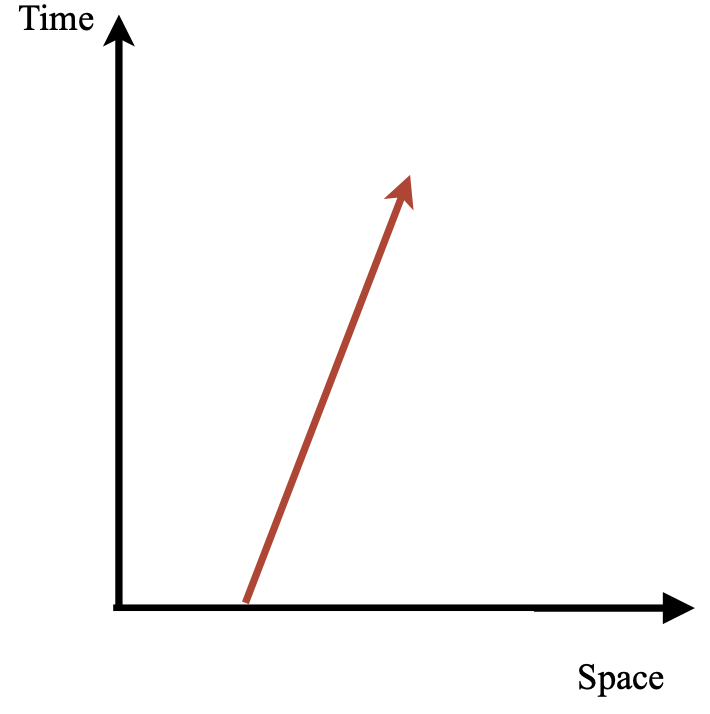
The particle's position is changing uniformly, at a specific well-defined rate with time. Classically, we are able to say that the particle has a certain value of position – we know where it is along the space axis – and we know its rate of change or the angle it is making with respect to the space axis.
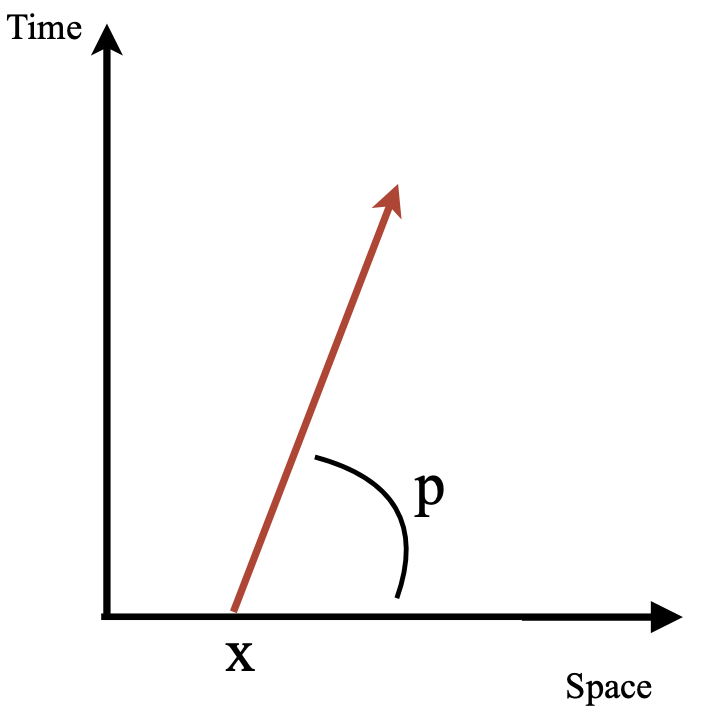
This angle gives the particle's velocity or, when multiplied by its mass, its momentum.
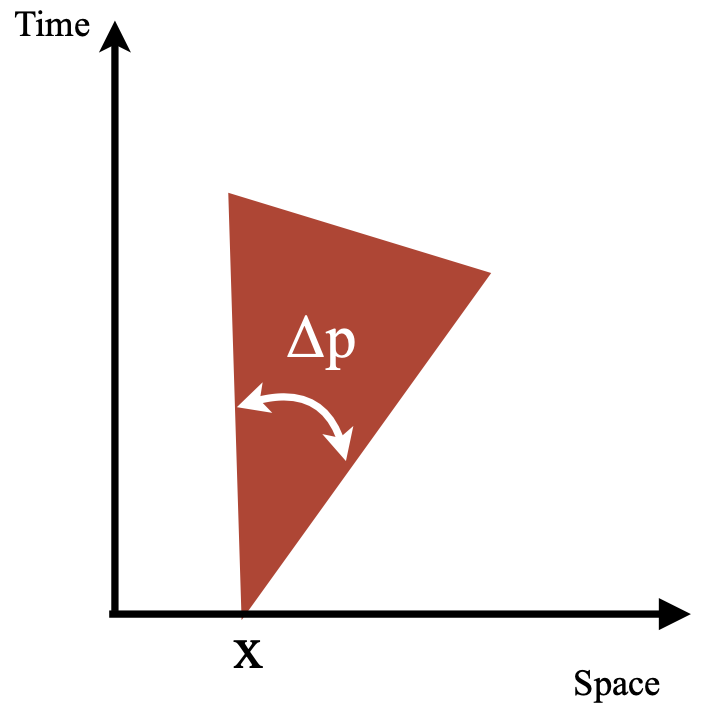
In the quantum world it turns out that these two quantities, position and momentum, are a kind of opposites to one another. Instead of drawing lines to represent particles in spacetime, QM tells us we need to draw thick wedges. For example, if we know the position of a particle precisely; ie: we know where it is along the space axis at a certain time, then we cannot know – at the same time – what direction it's moving in. In the figure below, we know precisely where the particle is at t=0 and therefore we cannot know its angle, or equivalently, its momentum. Instead of drawing a line, with QM, we are forced to draw triangles.
Another example of this duality between position and momentum is where we know its angle very precisely; we know its momentum very well. QM tells us that in this case we cannot know position precisely. Again instead of the geometric lines of classical physics, we are forced to talk about a thick wedge. Here we know the angle, but not the starting position.
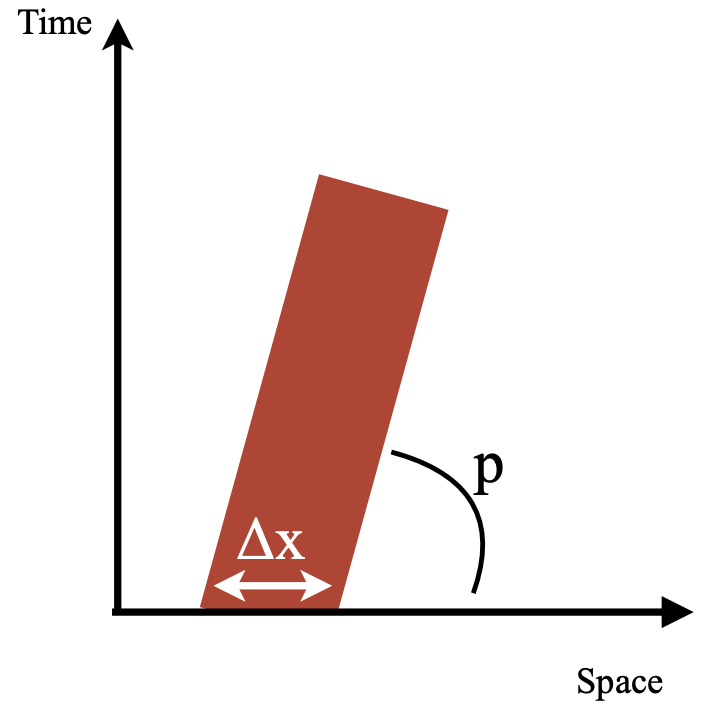
Infinitely straight lines are not allowed by QM. We can know the position precisely, in which case we need these triangles, or we can know the momentum precisely, in which case we must use these thick slanted rectangles.
The above examples are the edge cases, where we know either the position or momentum arbitrarily precisely. Typically in practice for particles like our muons, we will know its position with some finite uncertainty Δx and its momentum with some finite uncertainty Δp.
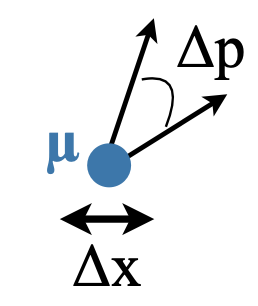
With QM we can know both things reasonably well, but we can't know them both arbitrarily precisely at the same time. The theory puts a numerical limit on how well we can know the product Δx Δp; the product is bounded by a new constant of nature \(h\): Δx Δp >= h. The non-zero value of h sets the scale for the thickness of the wedges in our diagrams.
An analogous argument can be made in terms of energy and time. In QM these are also a sort of opposite of one another, and the precision with which they can be simultaneously known is bound by a similar equation: ΔE Δt >= h.
The diagrams above give an intuitive understanding of the implications of the uncertainty principle. In the next post we will see where this position-vs-momentum duality comes from in terms of the QM amplitude.
I'm ignoring some factors of 2 and π for simplicity.