Higgs Series: Time Dilation and Evidence for Relativity
In the last post we saw that different observers will disagree on the position and time at which events happen. In fact, in the example we looked at, even the order of the events depended on the observer's perspective. However, all observers agree on the value of the interval: x² - ct². This mixing of space and time seems crazy and has many counter-intuitive consequences. In this post we will talk about one famous example.
If the interval between two events is negative, i.e. if the ct² part in x² - ct² is bigger than x², then the invariant hyperbola sits in the upper part of the space-time diagram:
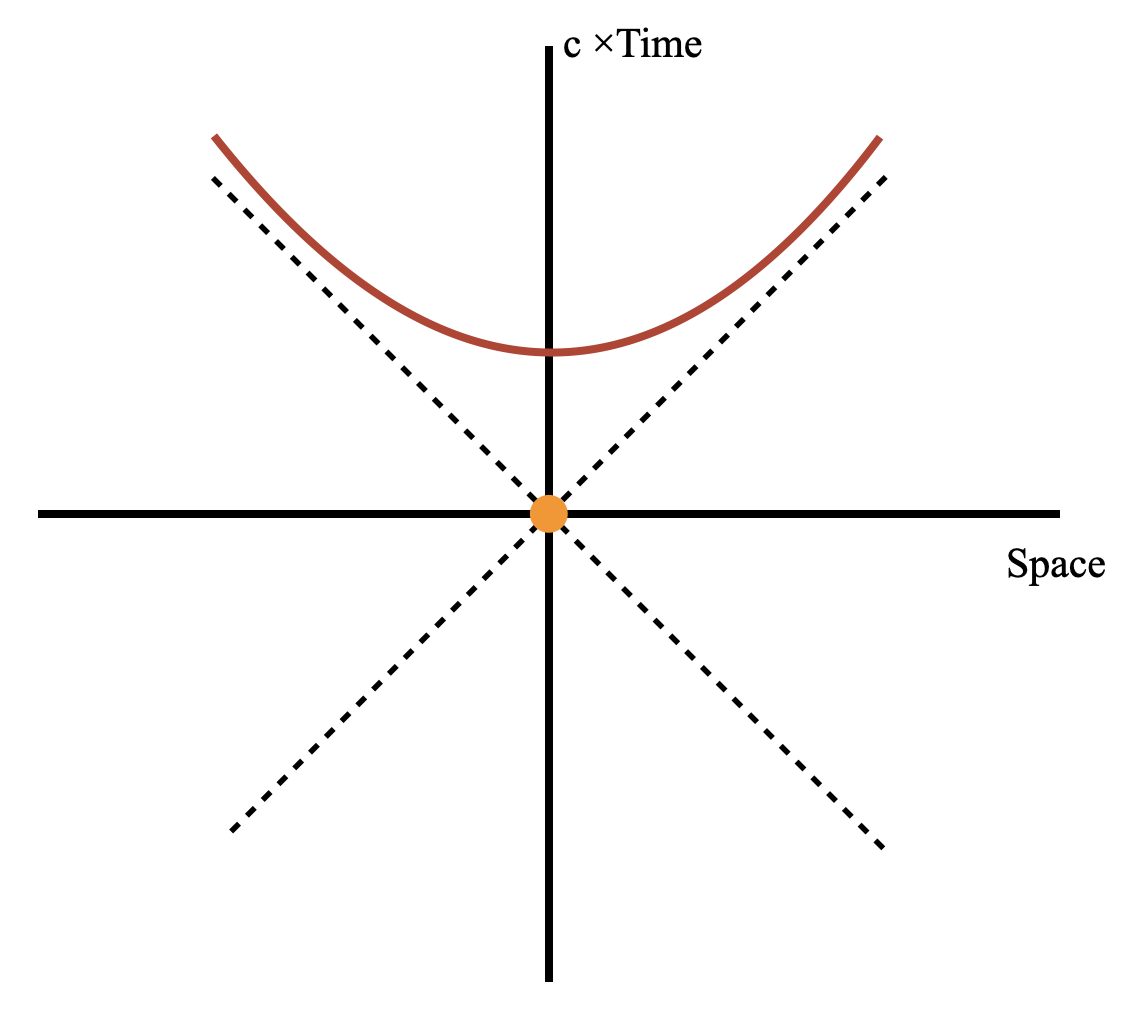
An example of something with a negative interval is a life: the space-time distance between someone's birth and death. Let's center the coordinate frame on their birth and indicate the location of their death, in their reference frame, by the blue point. Other observers in different reference frames will then see their death lying somewhere on the red line:
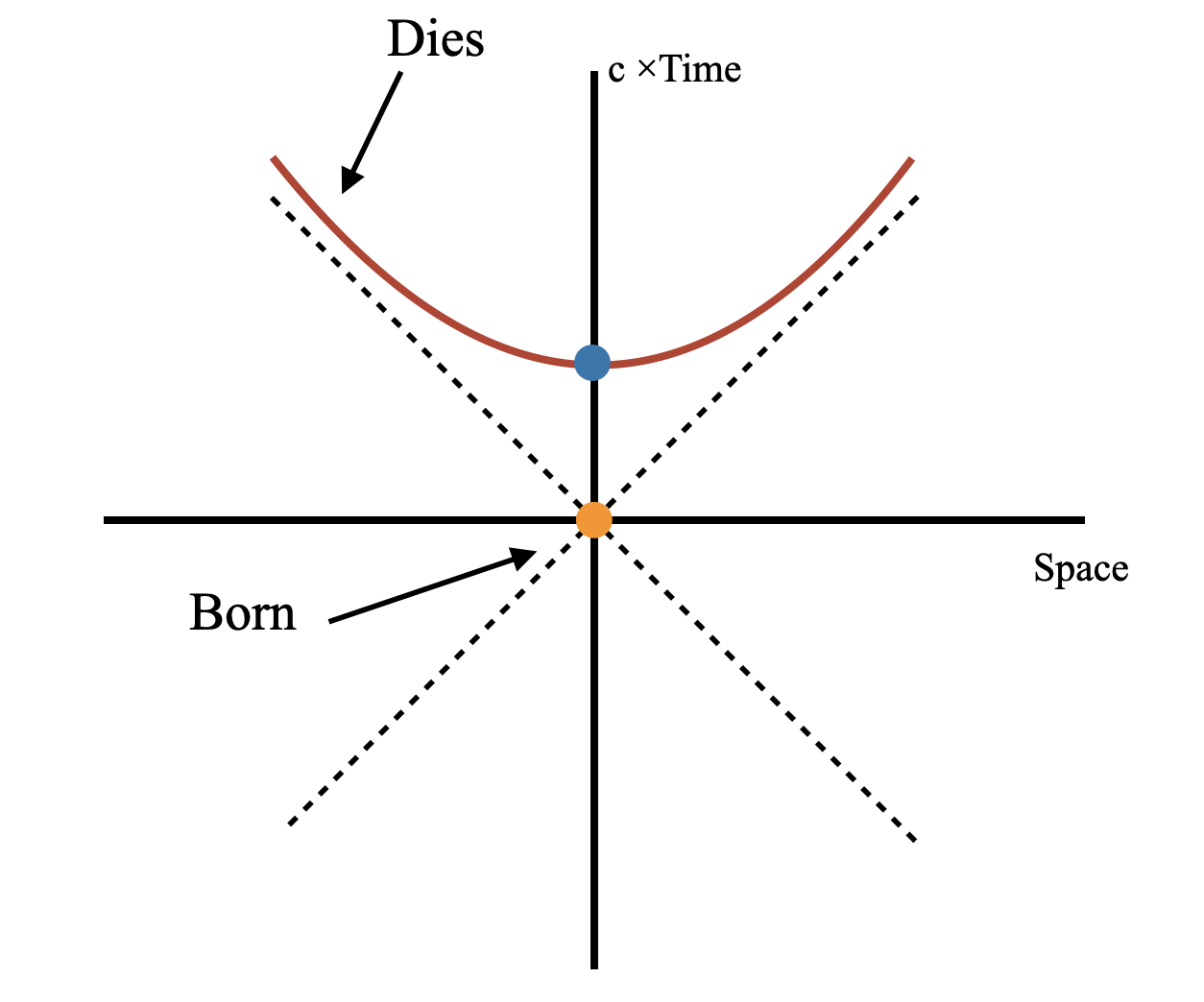
What's weird is that the moving observers will see the death taking place at different times. So the time difference between someone's birth and death – their lifetime – is observer dependent! This is called time dilation; moving observers see a longer, "dilated" lifetime. This seems preposterous, but it is true, and in fact one of the ways we know this story is correct is from exactly this example.
There are particles called muons that stream through our bodies all the time. Muons are fundamental particles in the Standard Model and will actually play a critical role later in our story of the discovery of the Higgs boson. You can think of muons as electrons, but 200 times heavier. Because they are so heavy, they can disintegrate or decay into electrons and some other light particles called neutrinos. It turns out there is a characteristic time for this muon decay to happen; that is, muons have a well-defined lifetime. On average, muons live about 2 microseconds. This lifetime can be measured very precisely. In fact, this measurement is one of the experiments that physics majors can do in a lab course at CMU.
Now, the muons that are streaming through us come from cosmic rays hitting the Earth. We have a good understanding of where and how this happens: muons are born in the stratosphere, ~15 km above sea level, traveling toward the Earth at nearly the speed of light (0.99985c). So we know when they are born, how long they live, and how fast they are moving. Without relativity, there would not be enough time for them to make it to the Earth's surface; even traveling at the maximum speed limit, they would on average decay after only ~0.66 km — only a tiny fraction of 10-10 would be expected to make it to the ground.
The fact that we see lots of muons streaming through our bodies and in the CMU undergraduate lab course is a direct result of time dilation. The muons are moving so fast that, to us, their lifetime is dilated many times the rest-frame measured value. Accounting for this factor, the muons should travel more like 25 km before decaying – over half would make it to the ground. Observing muons at sea level is direct qualitative evidence for time dilation and the theory of relativity.