Higgs Series: Time is Not Absolute
We said last time that imposing a strict, no-loopholes upper speed limit has profound implications. We are going to see a couple of examples of this in this post. We will start with time.
First, a confusing note on naming conventions. We often refer to the upper speed limit as "the speed of light". This is somewhat of a historical accident. It turns out – and there are deep reasons for this that we will come to later in this series – that light travels at the maximum speed. We already knew how fast light travelled before Einstein came up with the idea of an upper speed limit. So when Einstein proposed the maximum speed, the actual numerical value already had a name: it was how fast light travelled. If we are being loose we often conflate these two ideas; we say the "maximum speed is the speed of light". But I think it's clearer to think about this as two logically distinct statements: 1) there is an upper speed limit and 2) light moves at this upper limit. The upper speed limit is not something that is crucially dependent on light. You can imagine a world in which light moved slower than the upper limit. And in our world there are actually other things that move at the maximum limit: e.g. gravitational waves and neutrinos.~\footnote{Or at least we thought so for a long time until we started worrying that there was something wrong with the sun .... more on this later.}
OK, let's do an experiment. We turn a light on in the center of a room and we focus the light so we have two beams going out along the length of the room; left and right.
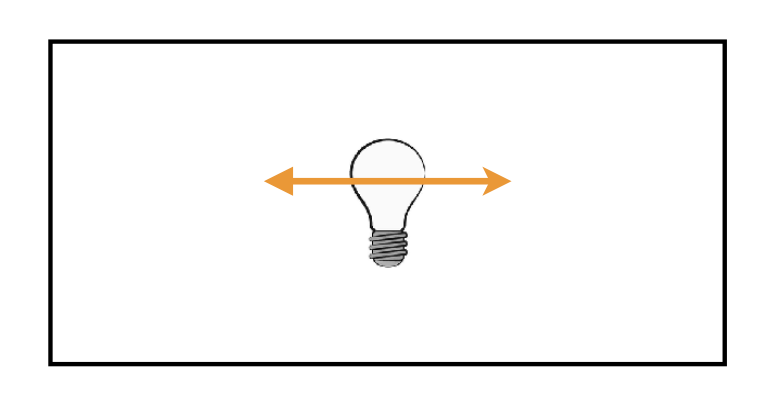
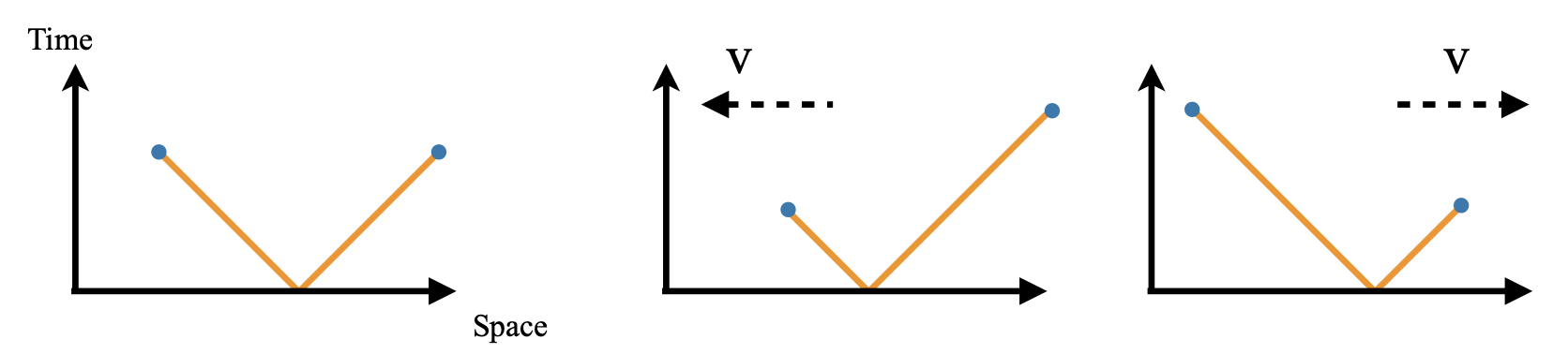
The light rays start at the center of the room and they travel toward the walls at "the speed of light", which we now know is the maximum speed. To someone standing in the room, the time-vs-space diagram looks like:
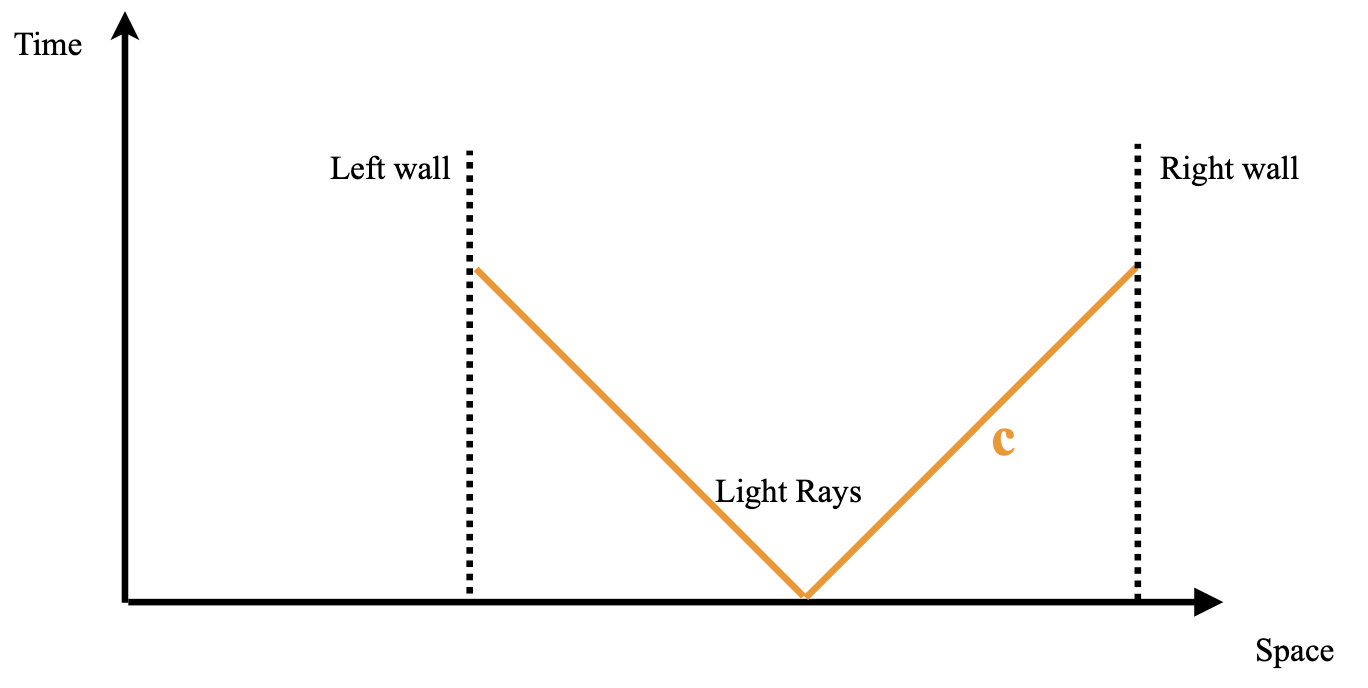
To the person standing still in the room, the walls are not moving; they are vertical lines in our diagram. The light rays are moving. There is some light that is going to the right at a 45-degree angle, the maximum speed. And there is some light that is moving to the left at a 45-degree angle. Now because the lightbulb is in the center of the room, the light rays strike the left and right walls at the same time. The figure shows this; left and right are moving at the same speed, they have to cover the same distance to get to their respective walls, so they reach them at the same time. Nothing surprising.
Now for the weird part…. Let's think in terms of an observer in the room who is running to the left. From his point of view, the walls are moving; the wall he is running toward is getting closer, the wall he is running away from is getting further away. However – crucially – to him the light rays are still traveling at the maximum speed, at 45-degree angles. This was the 2nd criterion that Einstein imposed to close the loophole of missiles firing missiles; the maximum speed is the same regardless of how fast you are already moving.
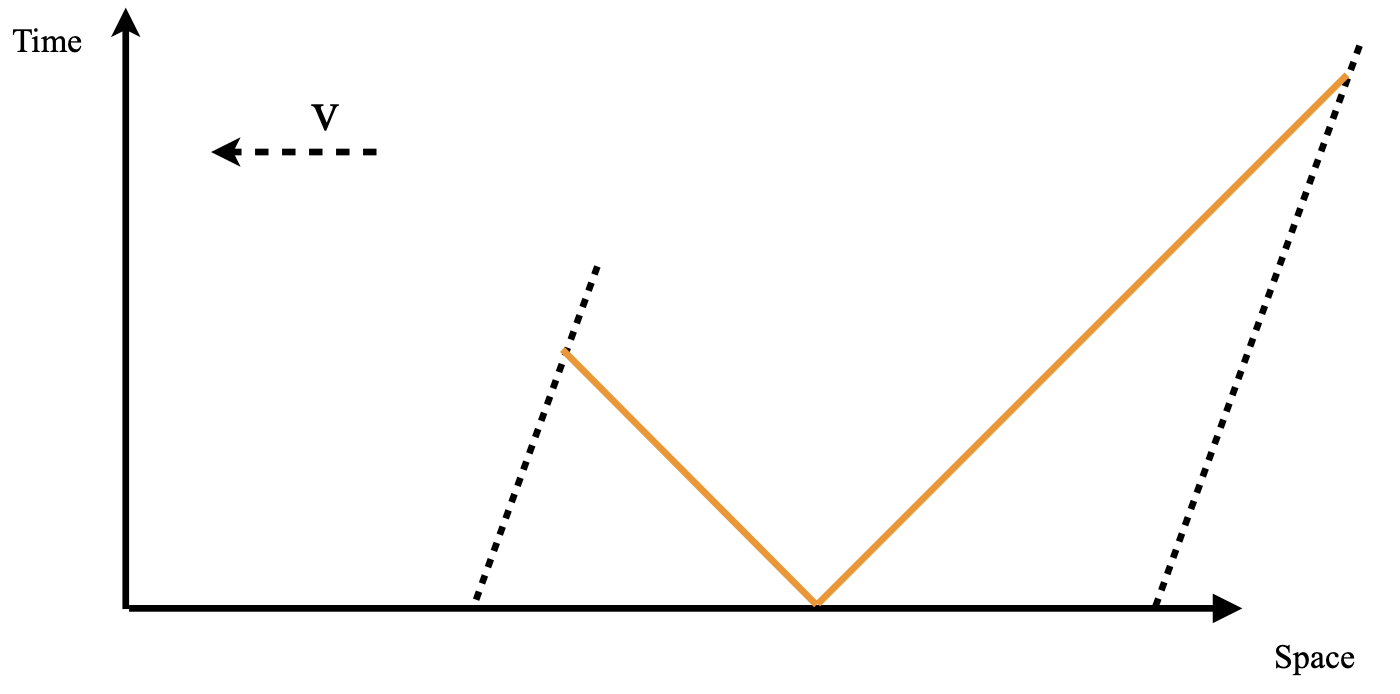 Now – in this POV – because the walls are not stationary, the left-going light doesn't have as far to go to reach the wall as the right-going light does. The moving observer thus sees the left-going beam hit the wall before the right-going beam does. As the light beams are traveling, the left-hand wall moves towards the light, and the right-hand wall moves away from it.
We can also imagine the same experiment from the POV of someone running to the right-hand wall:
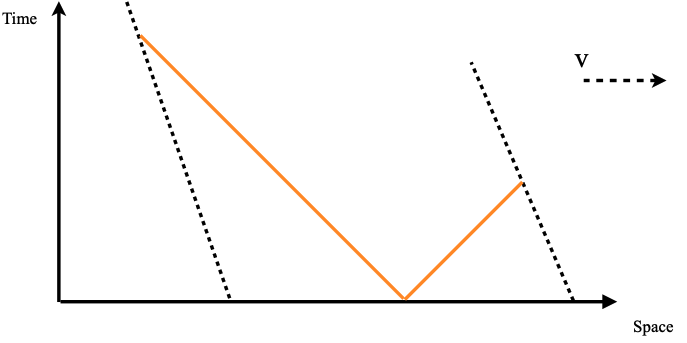 Now it is the right-going light beam that hits first.
What this is telling us is that time is not absolute. The question: Did the light beams hit the wall at the same time? depends on how you are moving; "Yes" to someone stationary with respect to the wall, "No" to a moving observer. Not only that, the order in which they hit the walls, and the time at which they hit, are observer dependent.
We will talk next time about what all this means and the right way to relate the different points of view.